

Water management educational opportunities
TIIAME
National Research University is the leading specialised institution for water
resources, irrigation and hydraulic engineering in Uzbekistan. The university
provides a comprehensive ecosystem of formal education, practice-oriented
training, lifelong learning and international cooperation in water resources
management. These activities target not only undergraduate and postgraduate
students, but also farmers, water-management practitioners, young researchers,
public officials and international partners, thereby directly supporting the
aims of SDG 6.5.1 – water management educational opportunities.
In
addition to accredited bachelor’s and master’s degree programmes, TIIAME NRU
organises national training initiatives such as the School of Water Workers,
international summer schools, technical seminars, joint laboratories and
field-based courses together with basin organisations, hydrometeorological
services, irrigation agencies and global industry leaders. The examples below
illustrate the breadth and depth of these educational opportunities in 2024.
1.
Formal
higher education in water resources and related fields
TIIAME National Research
University offers a range of educational programs and initiatives in water management,
catering to both students and local communities. The university provides
bachelor's and master's degree programs in fields such as Water Resources Management,
Hydraulic Engineering, Hydromelioration, Hydrology and Hydroinformatics, and
Environmental Protection. These programs are designed to equip students with
the necessary skills and knowledge to address contemporary challenges in water
management.
Students on these programmes
study subjects such as hydrometry, surface-water and groundwater hydrology,
engineering geology, irrigation and drainage, hydraulic structures, GIS and
remote sensing for water, and water resources economics. In 2024, second-year
students of these majors completed their field practice at the university’s
Scientific–Educational Centre, where they applied their classroom knowledge to
real measurements of flow, water level, groundwater, geological formations and
engineering-geological conditions in support of practical water management
tasks.
These formal programmes are
systematically aligned with the needs of the national water sector and provide
the foundation on which the university’s wider outreach and training activities
are built.
2.
National
outreach and lifelong learning: School of Water Workers
In addition to its formal
degree programmes, TIIAME NRU works actively with local communities to
strengthen capacity in the water sector. One of the most significant national
initiatives in this area is the “Suvchilar maktabi” (“School of Water
Workers”), launched on 29 May 2023 in partnership with Agrobank, the Ministry
of Water Resources and TIIAME National Research University. The primary aim of
this initiative is to upgrade the skills of farmers, water management specialists
and young professionals, and to familiarise them with modern irrigation
technologies, water-saving practices and digital management solutions. Within
the framework of the School of Water Workers, participants are offered
classroom-based theoretical courses, field-based practical trainings, expert
consultations and access to learning materials via digital platforms, with
activities gradually expanding across regions such as Fergana, Namangan,
Andijan and others. Since its establishment in 2023, the initiative has already
provided training to around 25,600 agricultural workers, 18,000 farmers and
6,400 mirabs (water managers) through mobile training courses delivered with
the direct involvement of TIIAME NRU academic staff.

Since 2024, the project has
entered its second phase, introducing several practice-oriented training
streams across the country, including the “Designer (Loyihachi)” course for
design engineers of contracting and construction organisations, as well as
specialised programmes on efficient water use for farmers and agro-clusters. In
2024 alone, approximately 30,200 agricultural workers, 19,100 farmers and more
than 10,400 mirabs have participated in these outreach and mobile training
activities, many of which were taught by professors and lecturers from TIIAME
NRU. These courses focus on integrating water-saving approaches into irrigation
and amelioration project design, rational use of water resources, field
moisture management, application of digital monitoring tools and improvement of
land reclamation conditions. To support this large-scale initiative, TIIAME NRU
academic staff have also developed more than 20 training manuals and
methodological guidelines specifically tailored to the needs of practitioners
in the water sector. Under the 2024–2030 concept, it is planned to deliver
one-week certification courses each year for thousands of farms, and this
systematic training process has already been launched step by step. Academic
staff of TIIAME NRU play an active role in planning these courses, developing
curricula and delivering both theoretical and practical sessions.
More information: https://suvchimaktabi.uz/
1.
Capacity
building for academic staff in water management
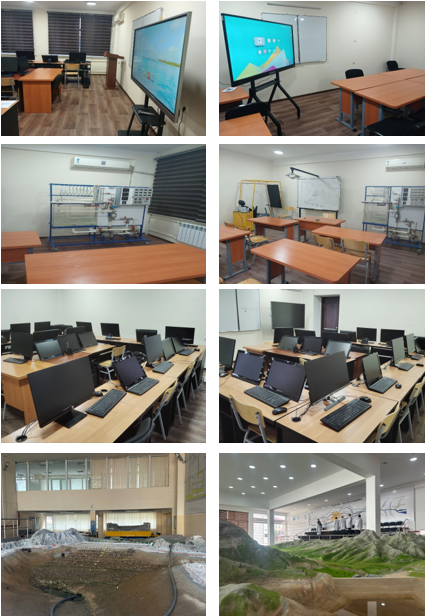
In addition to student-focused programmes, TIIAME NRU also invests in strengthening the qualifications of academic staff in the field of water management. At the Sectoral Centre for Retraining and Advanced Training of Pedagogical Personnel under TIIAME National Research University, a total of 40 teachers in the “Water Management and Land Reclamation” specialisation upgraded their qualifications in 2025, with a target of 50 teachers in 2026. Since 2025, the centre has also invited 10 international lecturers from partner institutions in the United Kingdom, the Islamic Republic of Iran, Kazakhstan, China and Turkmenistan to contribute to training courses. Modern teaching facilities support this work: three training rooms are equipped with interactive electronic boards, large-screen monitors, projectors, 24 internet-connected computers and demonstration units such as pump operation schemes and manipulators. These investments ensure that water-related education at TIIAME NRU is delivered with up-to-date methods and infrastructure, ultimately improving the capacity of future water professionals.
4.
Practice-oriented
training and dual education with water-sector organisations
TIIAME NRU emphasises close
integration between education, research and production through targeted visits,
mobile lessons and joint training with sector organisations.
4.1 Practice-Oriented Training
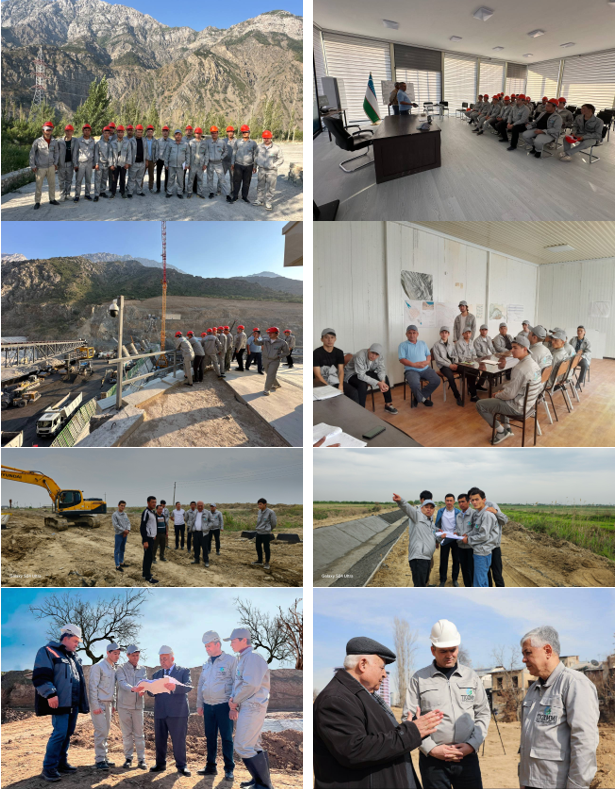
In addition, under a
cooperation agreement between the university and Uzbekgidroenergo JSC,
theoretical and practical classes are organized for students of the Faculty of Hydraulic
Engineering Construction at the company’s facilities.
In 2024, students of the
Hydraulic Engineering Construction programme took part in special classes and
field-based training at the design institutes of Uzbekgidroenergo JSC (Gidroproyekt,
Ozsuvloyiha) and at major construction sites, including the Pskem and Lower
Chatkal reservoirs and the Borijar canal.
4.2 Excursions and field practice at reservoirs and monitoring
institutions
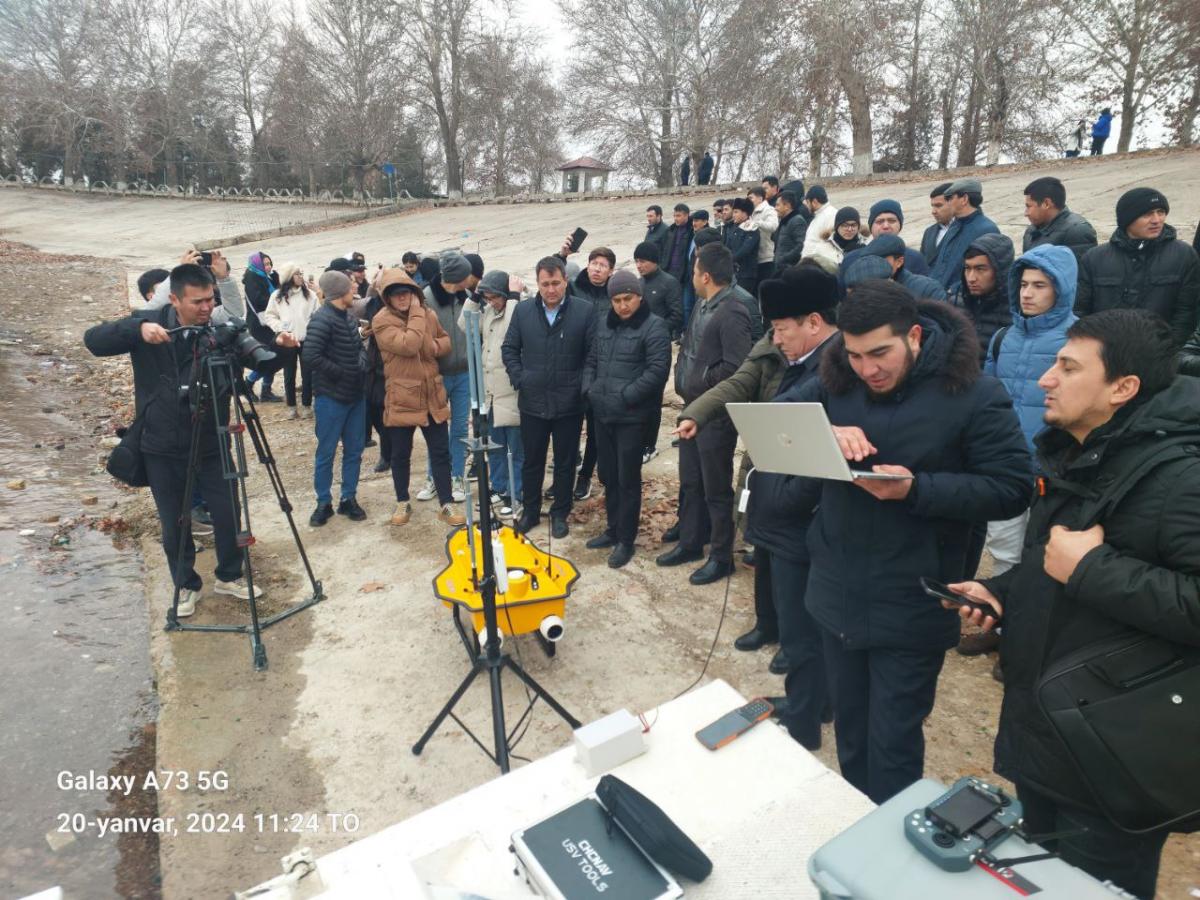
On 20 January 2024, an
educational excursion titled “Amaliy safarning nazariy zafari” was
organised to the Tashkent Reservoir for students specialising in water
management. During the visit, Ellips company staff demonstrated the
operation of the “Apache-3” acoustic flow-measurement device, while specialists
from the Agency for Space Research and Technology explained how reservoir
morphometric parameters are calculated using modern equipment and satellite
data, achieving 90–95% accuracy based on surveys at 23 reservoirs. The aim was
to develop students’ practical skills in using ultrasonic instruments and
remote sensing data for reservoir surveys and water-resources management.
https://tiiame.uz/news?id=5381
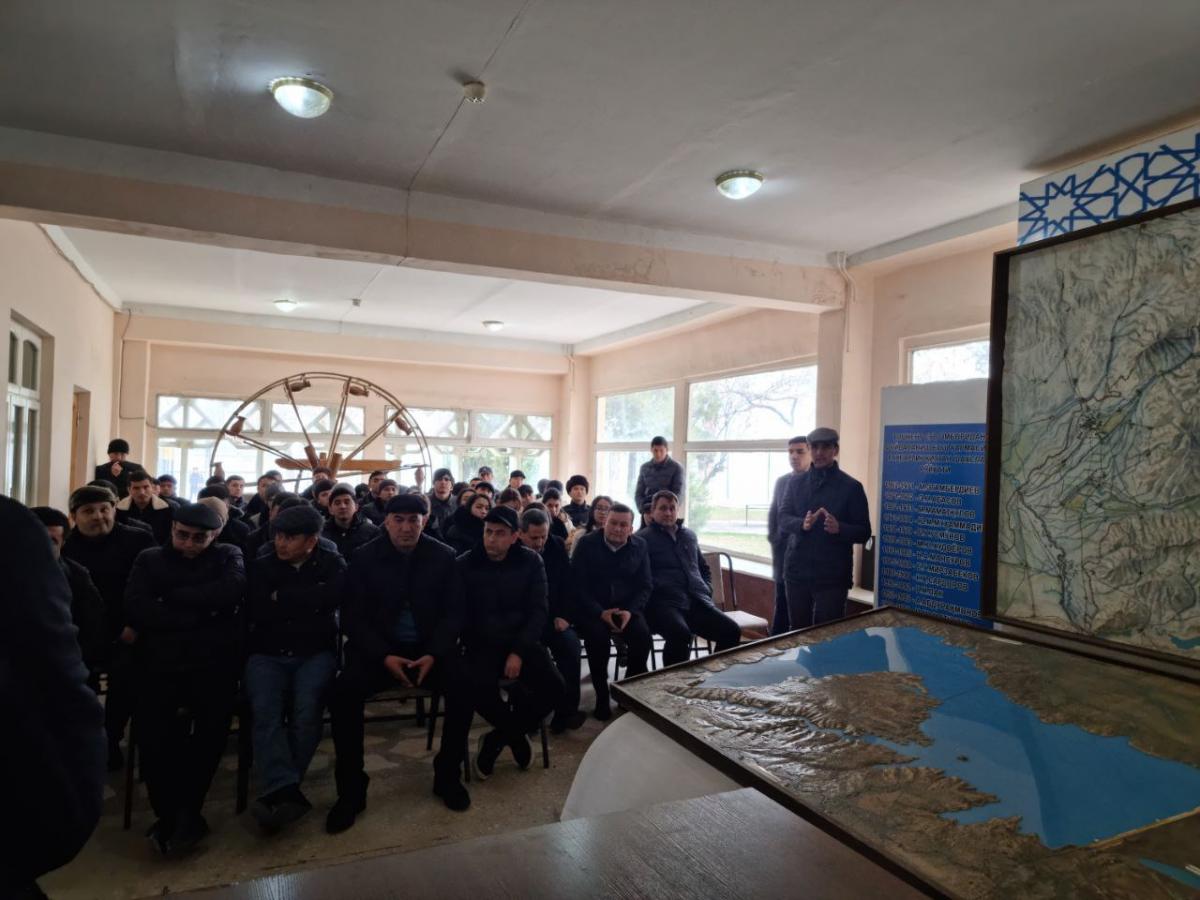
On 16 April 2024, third-year
students of Hydrology of Rivers and Reservoirs visited the Center of
Hydrometeorological Service (Uzhydromet). They learned about national systems
for collecting, analysing and disseminating hydrometeorological and climate
data, as well as the relevance of the course “Global climate and water
supply” to practical forecasting and risk assessment.
https://tiiame.uz/news?id=6107
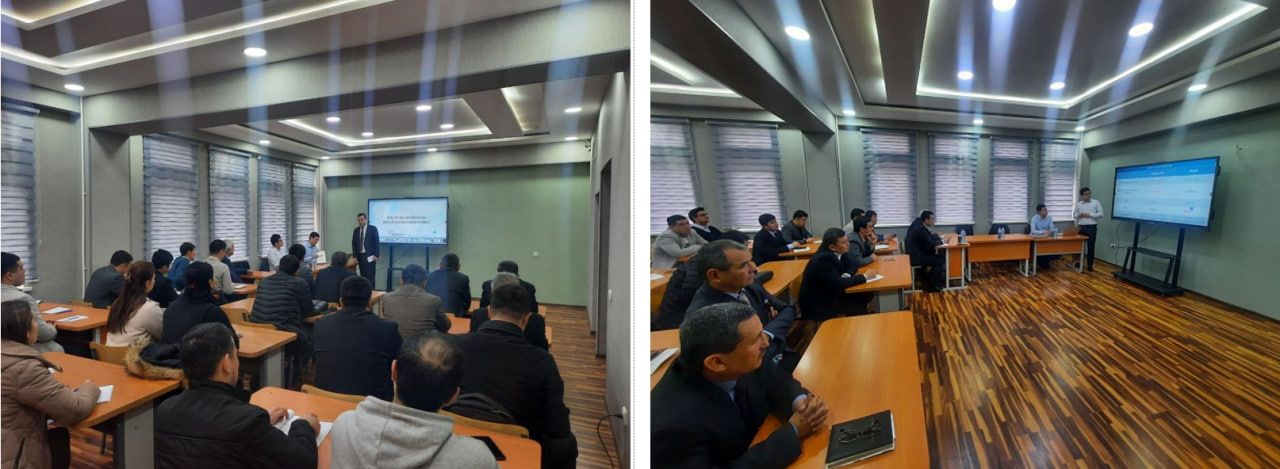
On November 7, 2024, a
practical session on the course "Use of Hydropower Installations" was
held at Akkavak Hydroelectric Power Station as part of the 5+1 program for
fourth-year students majoring in "Hydropower Facilities in Irrigation
Systems." During the practical session at the Ak-Kavak HPP, the students
learned about the process of electricity generation at the hydroelectric power
station. The equipment and devices at the HPP are highly complex, and it is
crucial for specialists to possess deep knowledge and experience to ensure
their reliable operation.
https://tiiame.uz/news?id=7336

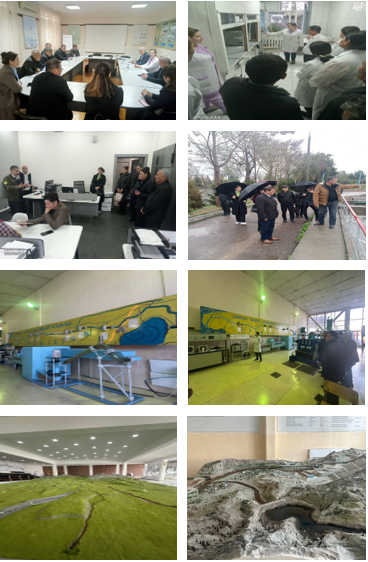
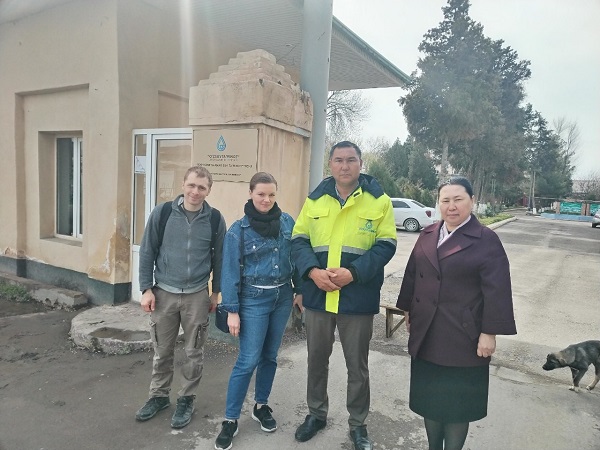
In March 2024, academic staff
and international partners visited the Salar wastewater treatment plant, where
they observed treatment processes and laboratory control of cleaning
efficiency. The visit strengthened understanding of urban water and sanitation
infrastructure and its role in environmental protection.
https://tiiame.uz/news?id=6008
4.1 Cooperation with Smart Solutions System and
Gidroproyekt
On 14 February 2024, academic
staff, doctoral students and young researchers from the Hydraulics and
Hydroinformatics Department visited Smart Solutions System. The visit
focused on automation and digital monitoring of water structures, pumping
stations, hydraulic nodes and reservoirs, in line with national strategies
(PF-6024 and PF-158) to modernise and digitalise water infrastructure.
Participants discussed innovative automatic control and measurement solutions
for water levels and discharge, and agreed on closer integration of university
research and industrial applications.
https://tiiame.uz/news?id=5679
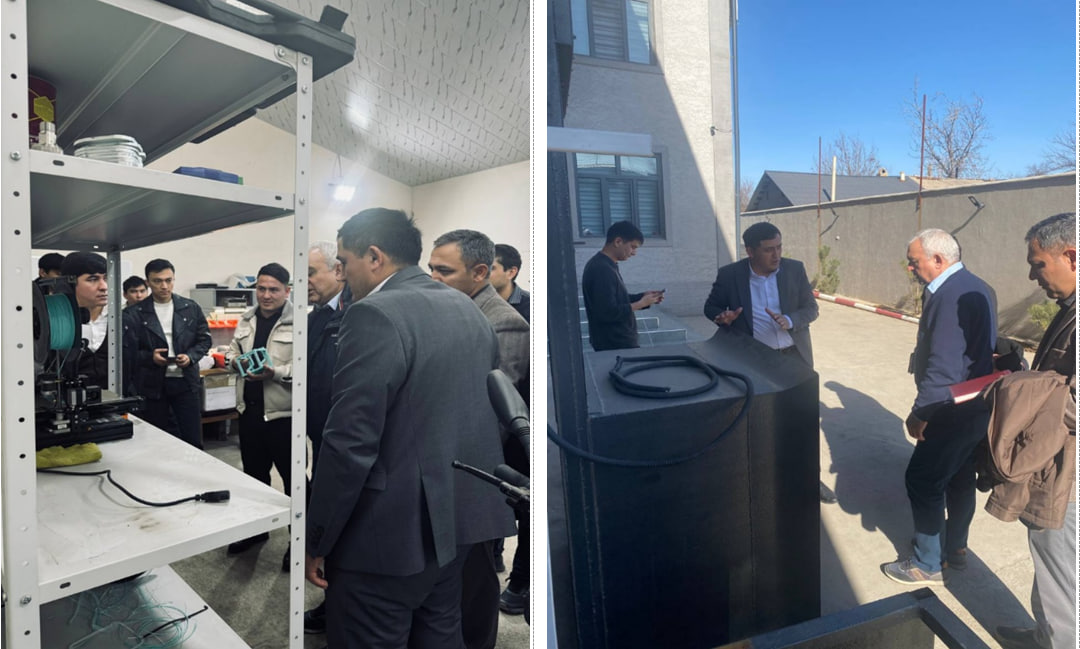
On 2 May 2024, students of Geodesy
and Geoinformatics attended a mobile lesson on Hydraulic Structures
at the laboratory of JSC Gidroproyekt. They observed physical models used to
assess the stability of planned dams and other structures and compared their
classroom theoretical training with real research and testing facilities.
https://tiiame.uz/news?id=6294
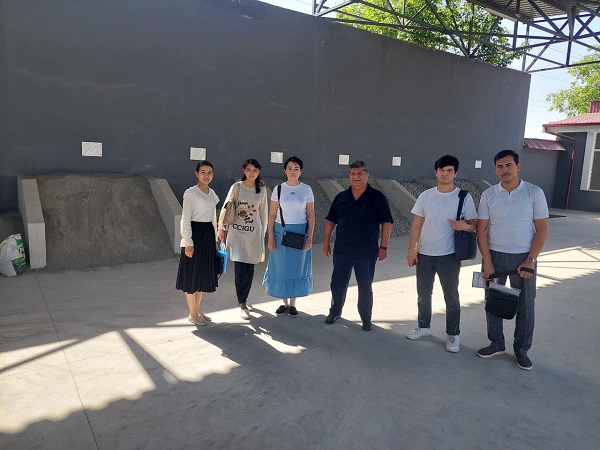
Through such collaborations,
students are systematically exposed to real-world infrastructure and modern
monitoring and modelling approaches, bridging the gap between theory and
practice in water management.
5.
Events
and trainings on efficient water use and irrigation technologies
5.1 World Water Day and wetlands events
Fevruary-March
2024, TIIAME NRU organised several high-profile educational events:
A round-table dedicated to World Wetlands Day on 2
February discussed the Ramsar Convention, the role of wetlands, water-saving
technologies in Uzbekistan and the classification of saline inland water
bodies, involving university students, staff and national environmental
institutions.
https://tiiame.uz/news?id=5500
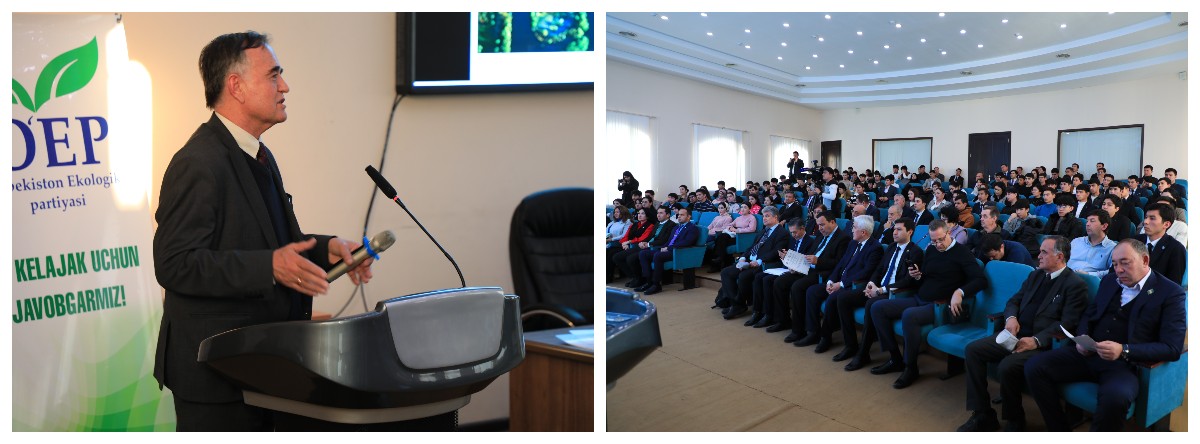
A major World Water Day round-table was held with the
Committee for the Development of the Aral Sea Region and Ecology of the Senate,
the Youth Parliament, the Environmental Movement of Uzbekistan and LLC Ecosuv.
Discussions focused on increasing irrigation water utilisation efficiency to
90–95%, expanding drip and other water-saving technologies, improving
groundwater assessment, and promoting the use of alternative water sources. A
subsurface drip irrigation system and its experimental results were presented,
and a Memorandum of Cooperation was signed, including a dedicated scholarship
from Ecosuv for Ecology and Law students.
https://tiiame.uz/news?id=5793
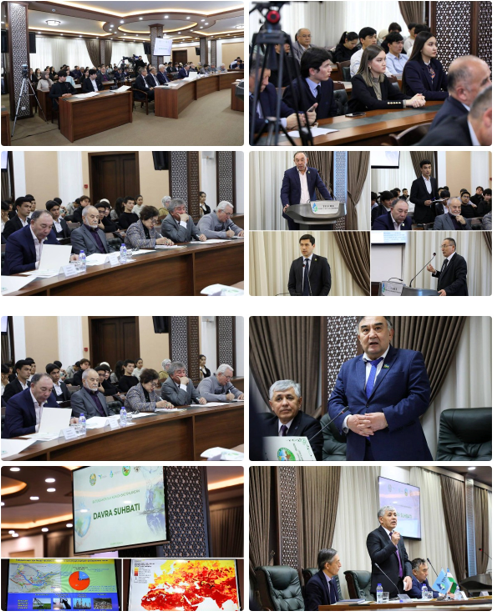
An additional World Water Day event under the slogan
“Water for Peace” on 15 March involved both chambers of the Oliy Majlis and the
Ministry of Water Resources, highlighting global and national water challenges,
climate change and the need to conserve water for future generations.
https://tiiame.uz/news?id=5871

On 13 March, a quiz on “Water for Peace” engaged Land
Resources and Cadastre students in interactive learning about water scarcity, conflicts
and cooperation.
https://tiiame.uz/news?id=5932

5.2 Seminars on water-saving irrigation and automation
On 12 March 2024, specialists from Netafim Ltd.
(Tashkent) delivered a seminar titled “Time for Water” for staff and
students of the Hydromelioration Faculty. They presented modern water-saving
irrigation technologies and greenhouse solutions adapted to Uzbek conditions,
discussed practical challenges in implementing these technologies under climate
change and water scarcity, and agreed on further cooperation for student
internships and joint projects.
https://tiiame.uz/news?id=5848

On 23 April 2024, a hybrid (online/offline) lecture on
“Automatic system for determining and controlling soil moisture” was delivered
by a lecturer from Tashkent State Technical University. Participants learned
how automated soil moisture monitoring and irrigation control can reduce water
and energy use in agriculture under water-scarce conditions and discussed
testing such systems at the university’s courtyard and Educational and
Experimental Farm.
https://tiiame.uz/news?id=6190

6.
Training
and research centres and joint laboratories
6.1
Training
and Research Center for Modern Water-Saving Technologies
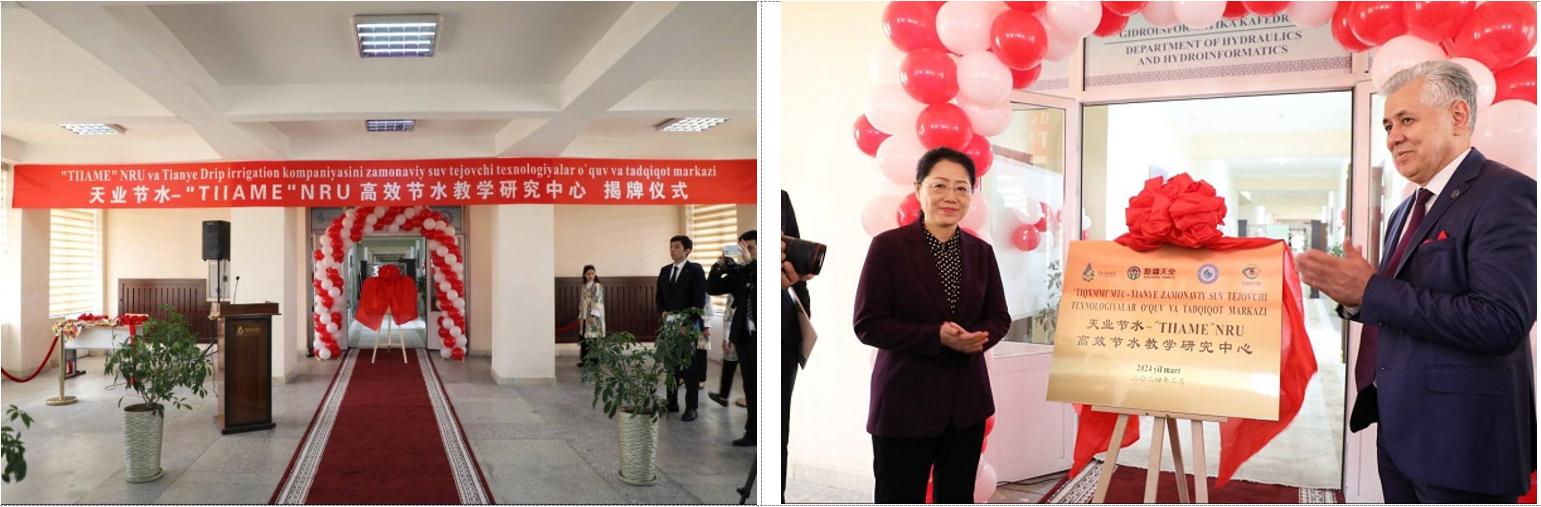
TIIAME NRU has established a
Training and Research Center for Modern Water-Saving Technologies in
cooperation with Xinjiang Tianye (China). The centre, based in the Hydraulics
and Hydroinformatics Department, is equipped with laboratory units for
different water-saving systems and tools for designing drip irrigation. Under
Tianye’s sponsorship, a 5-hectare educational and experimental field is being
developed at the university’s Educational and Practical Farm, where students
will conduct field training and experiments with modern irrigation
technologies.
https://tiiame.uz/news?id=6000
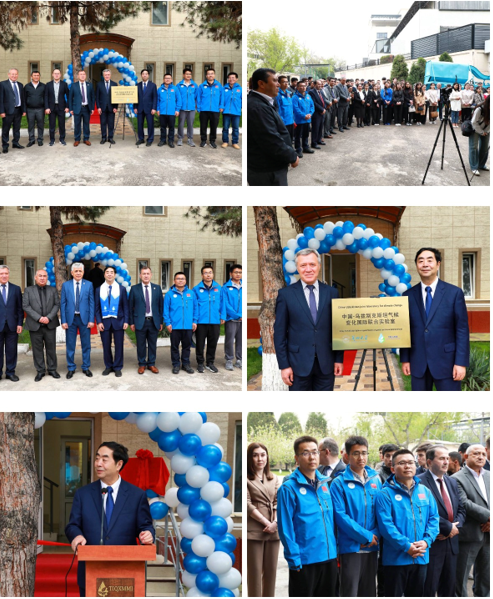
6.2 China–Uzbekistan
joint laboratory on climate change
In partnership with Lanzhou
University, TIIAME NRU has launched a China–Uzbekistan Joint Laboratory for
Climate Change Studies. The laboratory is equipped with a lidar, sun
photometer, fine particulate matter sensors and a mini meteorological station,
enabling advanced monitoring of atmospheric processes, dust storms and climate
impacts on water resources. It supports high-quality education and research on
climate and water, providing topics and data for theses, dissertations and
joint scientific publications, and will soon be complemented by a branch in the
Bukhara Institute of Natural Resources Management.
https://tiiame.uz/news?id=6097
7.
International
projects, summer schools and UNESCO Chair activities
TIIAME NRU actively engages in
international projects and networks that include strong educational components
in water management:
- Within the Horizon 2020 Hydro4U project, the
university participates in the adaptation of eco-friendly small hydropower
technologies to Central Asia. In 2024, the first ecologically sustainable
small hydropower plant with fish-pass and nature-based fish protection was
completed on the Koksu River (Shakhimardan). The demolition of a 3.5 m
artificial waterfall that blocked fish migration, and the new hydropower
plant, now serve as a live case study for teaching sustainable hydropower
and river restoration.
https://tiiame.uz/news?id=6441
- In March 2024, an online international lecture on
“Climate change and the importance of climate change mitigation”
was organised within the VEGERA project in cooperation with Eberswalde
University for Sustainable Development (Germany) and the University of
Fribourg. Students and staff learned about climate change in Central Asia,
the human factor in emissions and the role of economics in mitigation,
using interactive methods and questionnaires.
https://tiiame.uz/news?id=5931
- On 10 May 2024, the XXIII Scientific and
Practical Conference of Young Scientists, Bachelor, Master and Gifted
Students on “Modern problems of agriculture and water resources”
included a dedicated section on improving reclamation of irrigated lands
and introducing modern technologies for efficient water use. Students
presented and defended their research in front of academic staff.
https://tiiame.uz/news?id=6395
- The UNESCO Chair on “Water Diplomacy, Water
Resources Management and Environmental Protection” serves as a platform
for advanced education and high-level dialogue. On 11 October 2024, the
Chair hosted a meeting with Dr Mohamed A. Shehata Vahba, Honorary Vice
President of the International Commission on Irrigation and Drainage
(ICID), and Mr Yateng Wu from Dayu Irrigation Group (China). The meeting
introduced ICID’s educational activities, discussed challenges related to
salinity and water quality in Uzbekistan and explored opportunities for
joint pilot projects in water diplomacy and water-saving irrigation
technologies.
- https://tiiame.uz/news?id=7024
Through such initiatives,
TIIAME NRU positions itself as a regional hub for water diplomacy, climate
adaptation and sustainable water management education.
8.
Student
innovation, start-ups and international cooperation
TIIAME NRU also encourages
student-led innovation in green and water-related technologies:
- The student team “Hydroleaders” participated in
the “Green Start” programme within GIZ’s “Green Industrialisation in
Uzbekistan” project. Out of 258 applications, two of their projects (“Smart
panel” and “Air quality”) were selected as winners and received
financial support, demonstrating strong student engagement in
resource-efficient and environmentally sustainable solutions, including
better water and energy management.
https://tiiame.uz/news?id=5983
- A pre-competition promotional event for the “Smart
Agriculture / Smart Irrigation” innovation competition, organised by
the Ministry of Economy and Finance, UNDP and the Islamic Development
Bank, was held at TIIAME NRU on 28 March 2024. It encouraged students,
masters and young scientists to develop projects on smart agriculture and
smart irrigation for improved water resources management.