

Water consumption per person
At TIIAME National Research University, water consumption is monitored not
only for routine reporting, but also as a key indicator for management
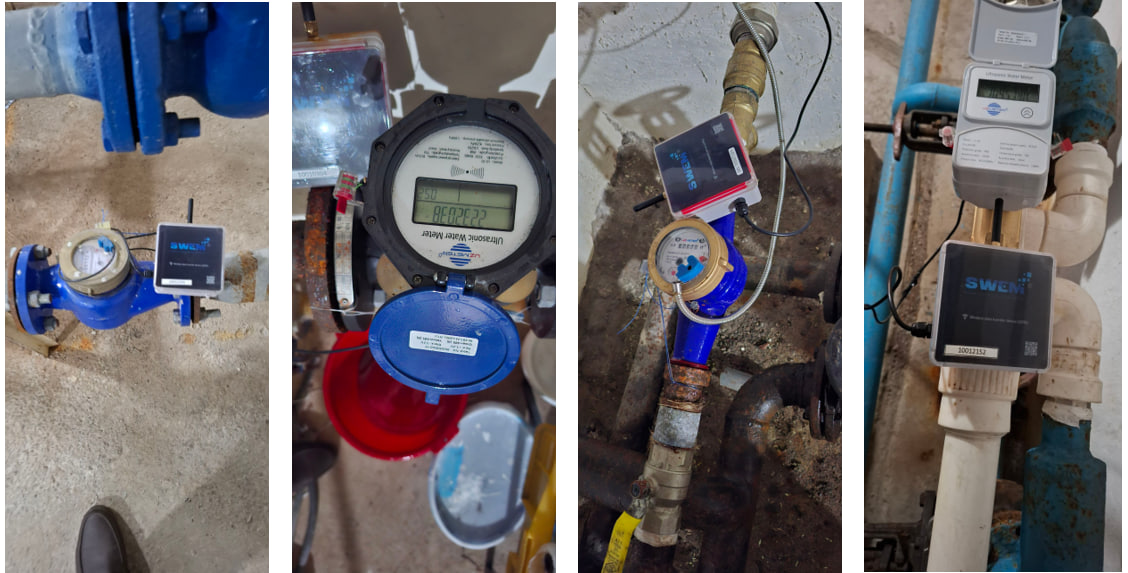
decisions. Nineteen main campus facilities – academic buildings, laboratories,
lecture halls, student residences, the research institute, the IT centre and
administrative buildings – are equipped with water meters. The readings from
these meters are taken every month and entered into a unified internal
monitoring system. This makes it possible to analyse consumption by building,
by season and in relation to the intensity of teaching and research activities.
By the end of 2024, total water consumption across the campus amounted to
101,000 m³. This is significantly lower than in 2023, when consumption was
141,875 m³. In other words, water use was reduced by almost 30% within a single
year. Taking into account that in 2024 the active campus population – students
and staff present on site – averaged 5,980 people, this corresponds to 16.9 m³
per person per year, or roughly 46 litres per person per day. For a large
higher education institution, this is a very acceptable level.
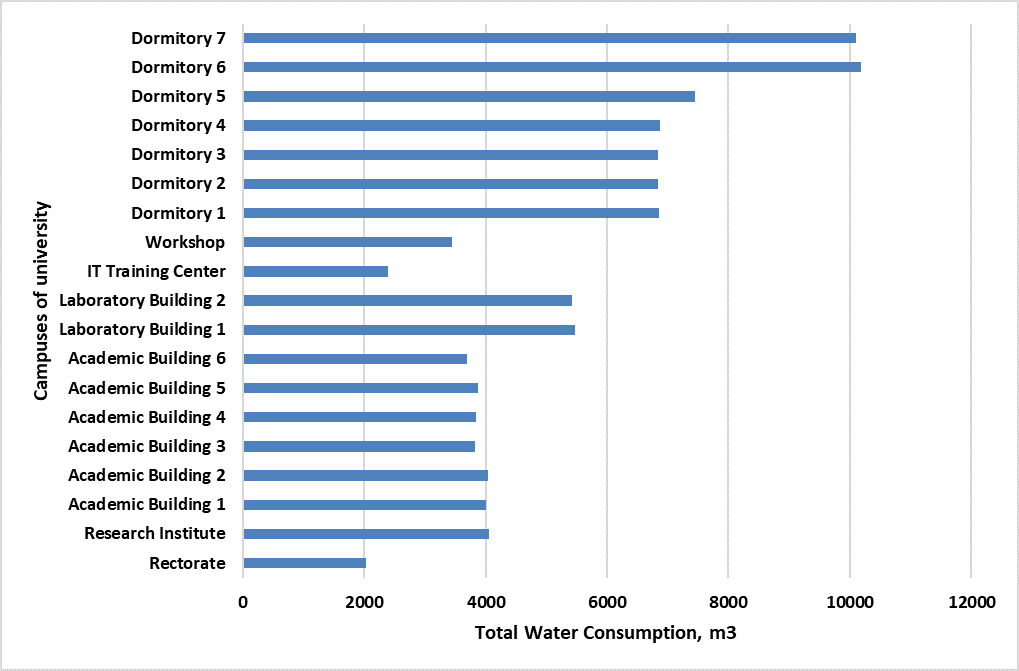
A breakdown by building type shows that per-capita water use in academic
buildings usually falls in the range of 22–35 L/person/day. In student
dormitories, the figure is higher – around 66–81 L/person/day – due to showers,
laundry and other household needs. At the research institute, per-capita
consumption is about 92 L/person/day, reflecting the larger share of
experimental work and equipment, as well as auxiliary uses such as
housekeeping, drip irrigation of plants and other technical needs. Laboratories
are not always in operation, but when they are running they require additional
volumes of water for experiments and cleaning. Seasonal variation is clearly
visible: consumption drops sharply during the summer break and rises again in
spring and autumn.
Several targeted measures contributed to the reduction in water use. First,
outdated sanitary fixtures in academic buildings and dormitories were gradually
replaced with low-flow taps, aerated showerheads and dual-flush toilets.
Second, the maintenance department implemented a stricter protocol for
detecting and repairing hidden leaks, which significantly reduced “lost” water.
This work was carried out in parallel with a review of water use in
laboratories and experimental facilities, where supply systems were
reconstructed using more energy- and resource-efficient technologies. In
previous years, a substantial share of total consumption had been associated
with laboratory and experimental activities.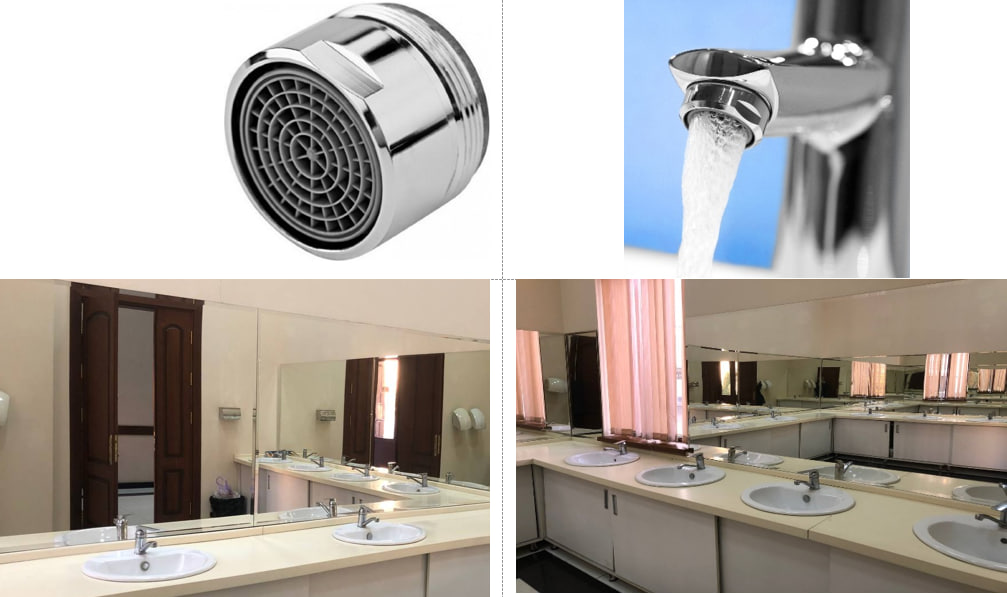
In addition, elements of an IoT-based smart irrigation system, developed by
university researchers, were piloted in several green areas on campus.
Initially designed for agricultural test plots, this prototype was adapted for
campus landscaping. The system collects real-time data on soil moisture,
pressure, flow and selected meteorological parameters, helping to avoid
unnecessary irrigation cycles and reduce water use during the vegetation
period.

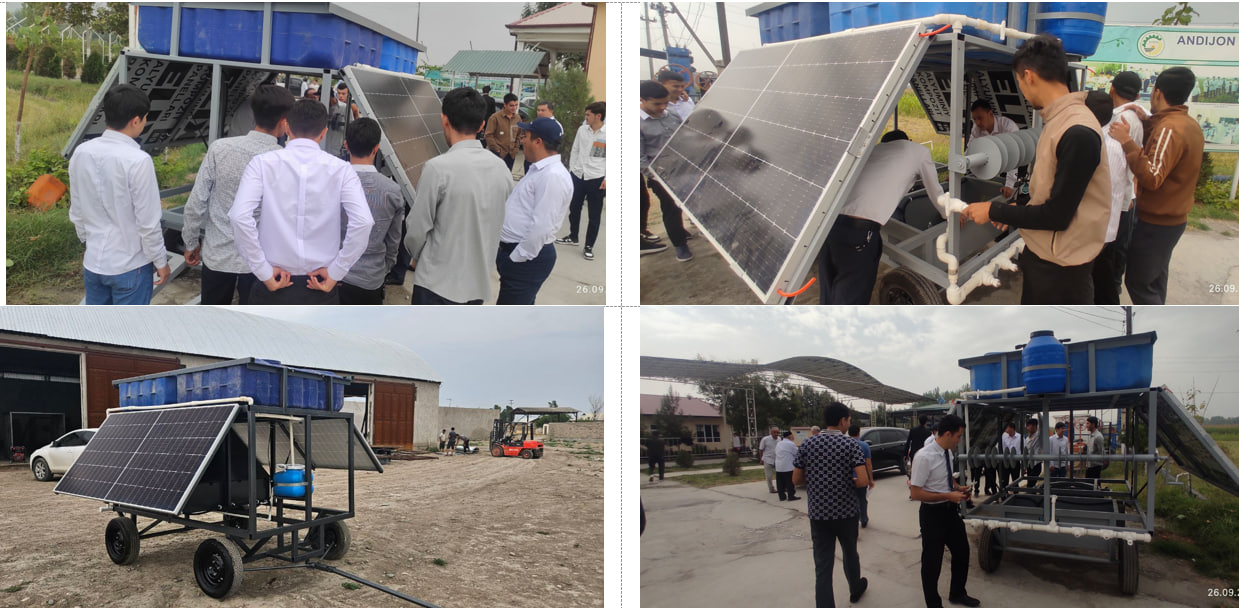
In some green zones, irrigation was also reorganised based on the
principles of a low-pressure mobile drip irrigation complex developed by TIIAME
engineers. Designed for low-infrastructure conditions, this technology was
adapted for campus use and helped to cut irrigation water demand by an
estimated 30–40% during the growing season.
Another important step was the pilot testing of intelligent pump control
algorithms at internal pump stations. These algorithms analyse fluctuations in
pressure, flow and power load, and automatically optimise pump operation. As a
result, idle running and over-circulation are reduced, energy consumption
decreases, and additional losses in the water system are limited.

Per-capita consumption indicators are calculated not on the basis of
nominal building capacity, but using actual occupancy and seasonal utilisation.
This ensures that the figures accurately reflect real conditions and provide a
sound basis for planning further measures in water management.
Overall, the marked reduction in water use in 2024 is the outcome of
technical modernisation, stronger internal discipline and the gradual
integration of TIIAME NRU’s own scientific innovations into campus
infrastructure. The university will continue to strengthen these measures in
the coming years, as improving water-use efficiency remains one of its
long-term strategic priorities.