

Address of the President of the Republic of Uzbekistan, Shavkat Mirziyoyev to the Oliy Majlis and the People of Uzbekistan
27.12.2025
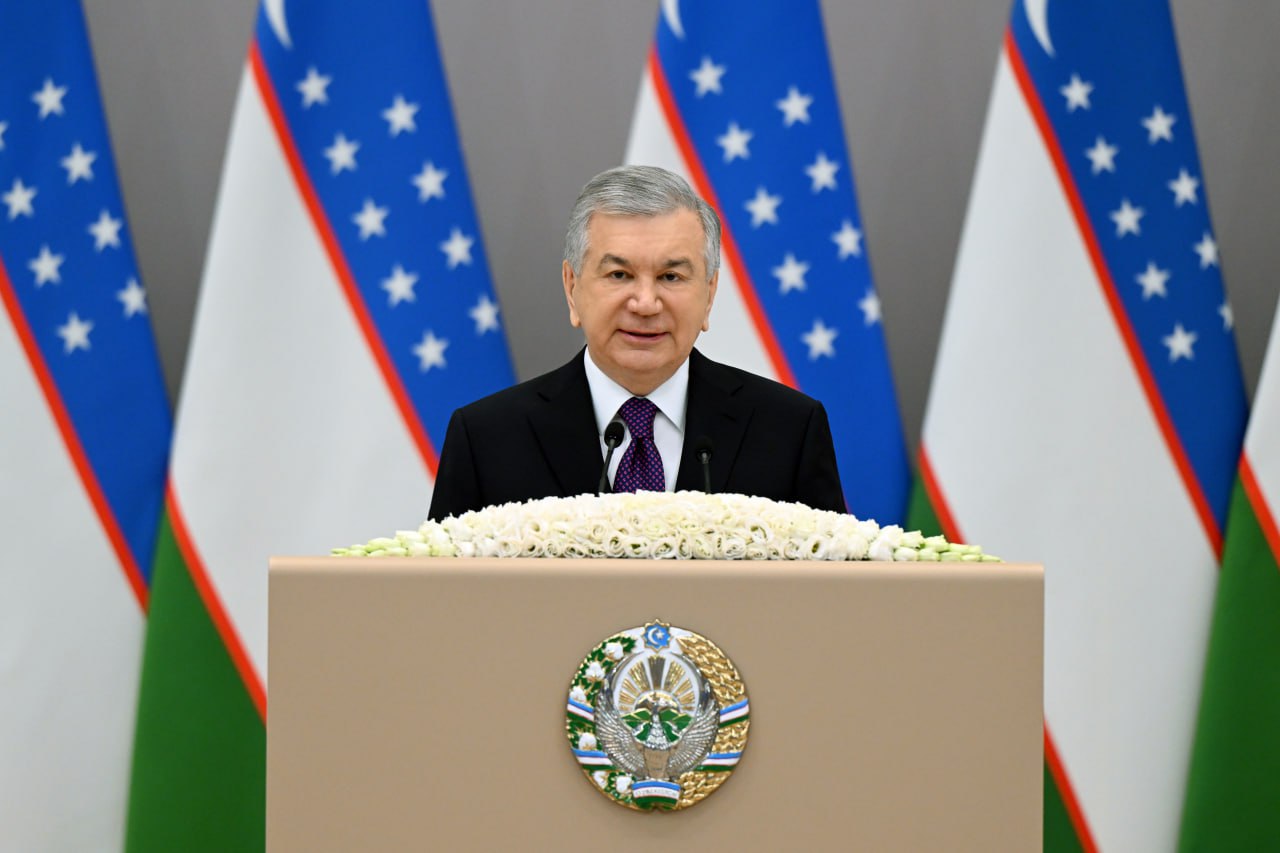
Dear compatriots!
Esteemed deputies and
senators!
Honored guests!
Today, as I present
the Address to the Oliy Majlis and to our multinational people for the coming
year, first of all I am pleased to see all of you in good health and high
spirits.
Over the past nine
years, together with you and with our people, we have traveled a great path of
development. Our economy has been reshaped, market relations and social
protection have been expanded, and the rule of law has been strengthened. Most
importantly, the results of our reforms are being felt in the daily lives of
every neighborhood, every household, and every individual.
In short, we have
learned to turn reforms into concrete practical outcomes. This is clearly
visible in our cities and villages, which are steadily taking on a new
appearance; in modern enterprises; in trade and service centers; in schools,
kindergartens, and hospitals; in well-kept streets and neighborhoods; in the
transport and logistics system; and in digital services.
Dear citizens!
At a time when the
world is undergoing changes that until recently no one could have imagined,
when economic confrontation between states is intensifying and threats to
security are increasing, we are concluding an extremely challenging year
together with you.
Despite how difficult
it has been, by resolutely continuing our democratic reforms; thanks to the
support of our people and the energy and enthusiasm of our youth; by
strengthening the role and influence of the mahalla as the foundation of
social unity; by transforming people’s mindset and worldview and further
consolidating our nation; through the initiative and courageous labor of our
entrepreneurs, farmers, and agricultural producers; and owing to our friendly
foreign policy based on mutually beneficial cooperation, we achieved major
successes in all spheres in 2025.
First of all, it
should be noted that even under global conditions where production and
transport-logistics chains have been disrupted and the prices of raw materials
and financial resources have risen, our country’s economy continues to grow
confidently and steadily.
These results are
being recognized by the international community and by reputable international
organizations.
Consider this: nine
years ago, reaching an economic volume of 100 billion dollars seemed like a
very ambitious milestone for us. This year, for the first time in our history,
our gross domestic product exceeded 145 billion dollars. Such high achievements
clearly demonstrate the tremendous potential of our people and of all of us.
At a time when the
“rules of the game” in the global trading system are changing, this year we
increased our exports by 23 percent, reaching 33.4 billion dollars. Most
importantly, our gold and foreign exchange reserves, which form a solid
financial foundation for our reforms, exceeded 60 billion dollars for the first
time.
This year, the volume
of foreign investments attracted to our economy reached 43.1 billion dollars.
The share of total investment in GDP stands at 31.9 percent. This creates a
strong basis for our economy to continue growing steadily at high rates in the
coming years.
Uzbekistan’s
international standing and prestige, as well as its position in international
rankings, are steadily strengthening. In particular, leading international
rating agencies upgraded our country’s sovereign rating from “BB-” to “BB.”
This may seem like a
simple fact to many. However, economists, investors, and bankers clearly
understand how significant this achievement is. As a result of this single
change, interest rates on external resources decrease by 1–1.5 percentage
points, reducing external debt servicing costs by at least 300 million dollars
per year.
In addition, in the
Technological Readiness Index published by the World Bank, Uzbekistan rose by
71 positions and entered the top 10 countries in the world.
The year 2025 also
became a year of major transformations in improving infrastructure that serves
to enhance public welfare and foster business growth. In particular, due to a
fundamental breakthrough in the energy sector, we increased electricity generation
to 85 billion kilowatt-hours.
Just imagine: if we
had remained at the 2017 generation level of 60 billion kilowatt-hours, would
we have been able to double the size of our economy today? Would it have been
possible to meet the growing demand of production and the needs of a population
of 38 million?
This year, clean
drinking water was supplied for the first time to households of 715,000 people
in 188 neighborhoods, and water supply was improved for nearly 2.3 million more
residents. In addition, water was delivered for the first time to irrigate household
plots of 470,000 families in 867 “difficult” neighborhoods.
This year,
multi-storey residential buildings totaling 8.1 million square meters and
comprising 135,000 apartments are being commissioned for the population. At the
same time, citizens themselves carried out construction on 19 million square
meters to improve their living conditions. Business entities built 24 million
square meters of non-residential facilities.
Overall, over the
past nine years, residential and non-residential facilities with a total area
of 210 million square meters have been put into operation.
I am emphasizing
these figures not without reason. If we had not found the necessary funding for
roads, water, electricity, and other infrastructure; if we had not created
favorable conditions for construction workers and building materials
enterprises; and if we had not put the mortgage system in place, would such
large-scale construction have been possible?
This year, 5 million
of our citizens gained stable incomes, and the unemployment rate decreased from
5.5 percent to 4.9 percent. Nearly 1.5 million people in need were lifted out
of poverty, and for the first time, 1,435 mahallas became “poverty-free”
areas.
A total of 168,000
children from low-income families were admitted to state kindergartens on
preferential terms. Starting this year, we introduced an inclusive education
system for the first time in 208 kindergartens.
It should be
emphasized that the poverty rate in our country declined from 8.9 percent at
the beginning of the year to 5.8 percent.
Recall that when we
began this work, nearly one-third of our population was living at the poverty
line. By establishing a completely new system of social protection through more
than 100 services such as loans, subsidies, and compensation and by entrusting
their implementation directly to the local “Seven” at the mahalla level, more than 8.5
million people were lifted out of poverty and unemployment was reduced by half.
As a result, we achieved this year the target we had set three years ago to
halve poverty by the end of 2026.
When speaking of our
most important achievements, it is also fitting to highlight with pride the
victories won by our determined and resilient athletes at prestigious
international competitions.
First of all, 2025
became a truly historic year for Uzbek football. Our national team qualified
for the FIFA World Cup for the first time ever. Our skilled chess players
performed with distinction in the World Cup competitions. In particular, the
achievement of our young grandmaster Javokhir Sindarov, who became the youngest
World Cup champion, fills us all with great pride.
Most importantly, our
successes in the chess world did not stop there. Last week, at the World
Championships in rapid and blitz chess among players aged 9 to 17,
representatives of our country won 5 gold, 2 silver, and 5 bronze medals,
taking first place in the overall team standings.
At this year’s Asian
Youth Para Games, our courageous and determined athletes won 125 gold, 77
silver, and 52 bronze medals, achieving the highest result among all
participating countries.
There is no doubt
that our talented young men and women are also making a worthy contribution to
the development of our New Uzbekistan through their major achievements in
education, science, culture, art, sports, and other fields.
This year, our
schoolchildren and students won 51 gold, 101 silver, and 126 bronze medals at
international academic olympiads, demonstrating their knowledge and potential
to the entire world.
Once again, we
sincerely commend these children who are the pride of our nation, as well as
their parents and teachers.
As is known,
Uzbekistan will host the 46th World Chess Olympiad next year, the FIFA U-20
World Cup in 2027, and the Asian Youth Games in 2029.
At the same time, in
2026, for the first time in our country, prestigious international chemistry
and informatics olympiads for school students will be held, along with
international olympiads in engineering fields among students of the Shanghai
Cooperation Organization member states, and vocational skills olympiads among
students of technical colleges of the Turkic states. I am confident that our
children will also participate worthily in these competitions.
Such prestigious
events serve to transform our Motherland into a country of advanced sports and
science and to enhance its international standing and prestige.
In recent times, our
country has been increasingly becoming an international platform for dialogue
on global issues. In particular, this year we hosted the 150th Anniversary
Assembly of the Inter-Parliamentary Union; a session of the UNESCO General
Conference; the “Central Asia - European Union” Summit; and the International
Climate Forum.
In addition, at the
meeting of the leaders of Uzbekistan, Tajikistan, and Kyrgyzstan held in
Khujand in March, a historic treaty was signed for the first time on the
junction point of the state borders of the three countries, and a Declaration
on Eternal Friendship was adopted.
During the recent
Consultative Meeting of the heads of state of our region in Tashkent, we put
forward the idea of establishing a strategic format of the Central Asian
Community in order to elevate integration processes to a new qualitative level.
The decision to admit Azerbaijan as a full-fledged member of the Central Asian
Community format was of historic significance. This step will undoubtedly
strengthen strategic connectivity and stability between Central Asia and the
South Caucasus.
At the same time, in
October, an Enhanced Partnership and Cooperation Agreement between Uzbekistan
and the European Union was signed in Brussels. The Central Asia–United States
Summit held in November served to elevate multilateral and long-term cooperation
to an entirely new qualitative level.
Last week in Tokyo,
at the meeting of the leaders of Central Asia and Japan, we reached important
agreements in the fields of education, healthcare, digital technologies,
infrastructure, and industry. Earlier this week, a meeting with the leaders of
the Commonwealth of Independent States in St. Petersburg also defined key
priority areas of our cooperation.
All of this is
bringing our international relations to a new stage in terms of substance and
depth.
We will continue to
build bridges of cooperation with countries both near and far around the world-with
the East and the West, the North and the South.
Esteemed participants
of the meeting!
When we adopted the
“Uzbekistan – 2030” Strategy two years ago, we set a goal of increasing our
gross domestic product to 160 billion dollars by 2030. As you can see, given
our existing potential, the scale of today’s reforms, the growing activity of
our entrepreneurs, and the expanding cooperation with our foreign partners, we
can confidently achieve this milestone as early as 2026.
In today’s global
economy, to remain competitive, it is essential to remember the decisive
importance of skilled professionals, qualified specialists, and modern
technologies. If we develop high value-added industries such as electronics and
electrical engineering, biochemistry and polymers, pharmaceuticals, and
mechanical engineering; expand high-income service sectors such as IT,
artificial intelligence, fintech, consulting, and transport and logistics;
widely apply bioengineering in agriculture to increase productivity, actively
use advanced agrotechnologies and water-saving methods; ensure a balance
between economic growth and environmental sustainability by transitioning to
green energy and waste-free production; and introduce new technologies to broadly
implement advanced foreign experience that elevates quality in education and
healthcare—while training personnel for modern, science- and innovation-based
professions—then we have every opportunity to increase the size of our economy
to more than 240 billion dollars over the next five years.
These figures are
forecasts based on precise and well-founded calculations. The conclusions of
the International Monetary Fund and reputable experts also confirm this.
Dear compatriots!
Today, we are a great
nation of more than 38 million people—resilient, proud, earning respect in the
world through our arduous and honorable labor, and moving forward boldly into
the future with confidence.
We do not live
waiting for change; on the contrary, we create it ourselves through our own
intellect, wisdom, and responsible labor.
Each year, our
population grows by an average of 2 percent, and more than one million of our
sons and daughters enter adult life. When we look at our youth and see their
achievements, our hearts swell with pride, and we take great pride in the
immense creative force that is joining our ranks.
Of course, in today’s
complex times, when it is essential to raise our youth as resilient and
patriotic individuals and to further unite and consolidate our people, the role
and importance of the mahalla a unique system of self-governance are
undoubtedly great.
The mahalla
and good neighborly relations are harmonious and complementary values. They
make an invaluable contribution to enriching human and social capital in
society. This is evidenced by the fact that more than 90 percent of
participants in social surveys conducted in our country consider themselves
part of their mahalla community.
For all of us, the mahalla,
which serves as both father and mother—and the strong sense of involvement
in the fate of the Motherland that arises from it show that this institution
is, above all, a source of social solidarity.
Indeed, in the
current era of global development, when extremely intense and dangerous
processes are taking place in the world, national unity is critically important
and indispensable for us.
Our wise ancestors
had a saying: “Those who unite prosper; those who do not unite perish.”
Indeed, history shows
that those who united succeeded in life and achieved victory, while those who
failed to unite fell apart and disappeared.
Throughout history,
no matter how severe the trials we faced, we first and foremost drew strength
from unity. In difficult times, our people and mahalla communities stood
shoulder to shoulder and overcame hardships together. Families supported
families, neighbors helped neighbors. We must always remain faithful to this
truly unique value and raise our younger generation in this very spirit.
Today, it is natural
for our society to have diverse opinions and views-this is a fundamental
requirement of democracy. However, regardless of nationality, language, or
religion, there is one great idea that unites our entire people: the interests
of the Motherland and the interests of our people.
In achieving such a
great goal, the role and influence of the mahalla system are
incomparable. For when the mahalla is peaceful and united, our society
is peaceful and cohesive; when the mahalla develops, our entire country
rises.
Taking all this into
account, I propose declaring 2026 in our country as the “Year of Developing the
Mahalla and Advancing Society.”
Thank you for your
support.
To implement the
priority tasks set out in the name of the New Year, we will adopt a separate
state program. This program will certainly reflect urgent issues such as
transforming more than 9,000 mahallas across our country, first and
foremost, into centers of compassion, solidarity, justice, and upbringing. I
will speak about this in more detail later.
We will achieve the
goals we have set only together—with our mahalla chairpersons and
activists who possess great life experience, our respected elders, our sisters,
our energetic youth, our intellectuals, our enterprising businesspeople, our
defenders of the Motherland—in short, together with all our people.
Esteemed deputies and
senators!
We are stepping into
a decisive stage in building the New Uzbekistan. Our efforts along this path
require deep transformation in every sphere and sector. Our goal is clear: in
the coming years, to join the group of countries with above-average per capita
income.
From the Fergana
Valley to the Aral Sea region, from the Zarafshan Valley to Kashkadarya and
Surkhandarya, from Tashkent to Jizzakh and Syrdarya- no matter which region of
our country they live in, every citizen must feel the results of the reforms
more strongly in their daily lives. Therefore, the incoming year 2026 will be a
year of fundamental breakthroughs in developing all areas-public
administration, the judicial and legal system, economic sectors, education,
science, healthcare, culture, sports, and environmental protection.
Now I will dwell in
detail on the main part of the Address-a program consisting of the six most
important priority areas to be implemented in 2026.
The first priority
area is to further improve mahalla infrastructure and to bring the image
of the New Uzbekistan into them.
The prosperity of the
country begins, first and foremost, with the mahalla. It is precisely by
the conditions of roads, water supply, electricity, and transport, as well as
kindergartens, schools, and family clinics in the mahalla, that people
judge our reforms. Therefore, the development of the mahalla system has
been and will remain a priority direction of state policy.
By fundamentally
improving mahalla infrastructure, we will continue efforts to
comprehensively develop our country and make its appearance even more beautiful
and prosperous.
At present, in some mahallas
solutions are being provided separately—roads in one, water or electricity in
another, kindergartens, schools, or healthcare in a third, and housing issues
in yet another. Frankly speaking, this alone does not fully resolve all issues
at the mahalla level. Therefore, starting next year, a comprehensive
approach to mahalla development will be introduced.
In each region, we
will select two or three districts and create a system in which all problems in
every mahalla within those districts are resolved simultaneously. We
have begun this new approach in Urgut District, where a modern eco-city
designed for 100,000 residents will be built. Next year, 544 billion soums will
be allocated to construct and renovate 72 kindergartens, schools, and
polyclinics, as well as internal roads; to line canals with concrete; and to
build two flood-control reservoirs.
The same approach
will be applied in 33 selected districts and 330 disadvantaged mahallas.
At the same time, entrepreneurial infrastructure will also be developed there.
For these purposes, a total of 8.5 trillion soums will be allocated from all
sources.
To enable deputies to
resolve issues in their constituencies, we are allocating 500 billion soums in
total, or 3.3 billion soums per deputy. In addition, an extra 330 million soums
will be allocated to each deputy’s initiative to create “green zones” and
“green parks.” Through this approach, we will bring the image of the New
Uzbekistan to mahallas in all districts by 2030.
Of course, to
organize this work effectively, it is necessary to create conditions to at
least double district budget revenues. For this purpose, starting from January
1, 2026, 5 percent of value-added tax revenues in Tashkent and 20 percent in
other regions will be retained, with half of these funds transferred to
district budgets.
In addition, 50
percent of revenues collected above forecast targets, as well as all revenues
from leasing agricultural land and from markets, will be fully transferred to
district budgets.
Regional and district
governors will be allowed to reduce inefficient and duplicative staff positions
and allocate the resulting savings to addressing issues raised by the
population. Through this measure, an additional 5 trillion soums per year will
be generated in district budgets and directed toward improving mahalla
infrastructure.
Next year, for the
first time, we will allocate 20 trillion soums directly to the regions for the
development of mahalla infrastructure. Most importantly, every soum of
these funds must create added value for our people. Therefore, this money will
not be allocated simply to districts, but rather directed to specific projects
that create jobs in mahallas and increase people’s incomes.
Any mahalla
chairperson, assistant to the governor, or mahalla banker who prepares
and substantiates a project should receive the necessary funding—this will
ensure fairness.
This will represent a
project-based approach to the effective use of budget funds.
We will also launch
new reforms in urbanization and the sustainable development of cities. In
particular, we will establish clear criteria to prevent the chaotic expansion
of cities, thereby stopping the unjustified reduction of agricultural land.
For example, if
cities with populations exceeding 250,000 continue to expand chaotically as
they do now, by 2050 we will lose 27,000 hectares of agricultural land. Of
course, this cannot be allowed.
In addition, for the
first time in our republic, we will designate 45 agglomeration areas. Next year, we will
launch the “Sustainable City” platform and introduce a “livability index.”
Through this index, the specific problems of each mahalla in cities will
be identified, and tailored solutions will be provided.
We have turned the
issue of poverty reduction into a nationwide movement. I reiterate that in the
past period we have succeeded in lifting more than 8.5 million people out of
poverty.
Our main goal is to
ensure that our people have permanent sources of income. A person with income
strives to dress and eat well, to access quality education and skilled medical
services, to enjoy meaningful leisure in short, to live a prosperous life.
Most importantly, in
this process our entrepreneurs stand at the forefront as a decisive force establishing
industrial and service facilities, creating permanent jobs, and showing special
dedication in training our population, especially youth and women, in
professions, and making them employed and income-earning within their own mahallas.
Therefore, we will continue our policy of supporting entrepreneurship and, in
2026, keep the main tax rates unchanged; allocate more than 10 trillion soums
for entrepreneurship infrastructure projects; and provide 140 trillion soums in
resources to develop small and medium-sized businesses. Of this amount, 43
trillion soums will be directed to supporting women’s and youth
entrepreneurship.
In addition, in 2026,
under the “Industry and Services in the Mahalla” project, 5 trillion soums in
loans will be provided to launch more than 10,000 production and service
projects. The portion of loan interest up to 10 percent in national currency
and up to 4 percent in foreign currency will be subsidized by the
Entrepreneurship Company. For this purpose, 400 billion soums will also be
allocated from the budget. As a result, 100,000 new jobs will be created in mahallas.
By implementing 40
micro-projects in each mahalla, an additional 7.5 trillion soums in
resources will be allocated in 2026 to mahalla bankers and assistants to
district governors to employ 360,000 people.
In the new year, we
will adopt a three-year program to widely engage residents of mahallas,
especially women, in sports and to create the necessary infrastructure for this
purpose, allocating 1 trillion soums. To further increase young people’s
interest in reading, we will supply school libraries each year with 10 million
copies of fiction books.
Thanks to these
measures, in 2026 we will provide permanent employment for 1 million people,
lift 181,000 families out of poverty, reduce the poverty and unemployment rates
to 4.5 percent, and increase the number of poverty-free mahallas to
3,500.
Dear compatriots!
Our second priority
area is transitioning the economy to a model of technological and innovative
growth.
In today’s conditions
of intensifying global competition, only countries that produce high
value-added products secure a strong position in world markets. Therefore,
achieving high efficiency across all sectors of the economy must become the
main criterion of our reforms going forward.
For example, by
developing high-tech and energy-efficient industries, this year we reduced fuel
and energy consumption per dollar of output by 13 percent. This alone created
an additional 1 billion dollars in added value.
This example clearly
shows that where there are new technologies and highly skilled professionals,
growth and development follow in that sector.
Therefore, the most
correct path to increasing gross domestic product to more than 240 billion
dollars by 2030 is to transition all sectors to a model of technological and
innovative growth. This will be the main direction of our economic development
strategy in the coming years.
The favorable
business environment in our country, demographic growth, and the attention
being paid to human capital are turning Uzbekistan into one of the most
attractive countries for investors. For example, over nine years we have
attracted 130 billion dollars in foreign investment across all sectors of the
economy. This year alone, we have reached new investment agreements worth
another 140 billion dollars with our foreign partners.
Next year, we will
attract 50 billion dollars in foreign investment. From now on, every dollar of
investment must primarily serve the introduction and transfer of advanced
technologies; the production of high value-added products with clearly defined
external markets; increasing efficiency in the use of energy, water, land, and
other natural resources; training local workers to operate new technologies and
boosting labor productivity. In other words, an investor who brings high
technology and new competencies and works for export will be our most reliable
partner.
For such strategic
investors, land for projects will be allocated directly at market value. When
the category of land is changed, compensation payments for losses will be
allowed to be paid in installments for up to 10 years. Investors will no longer
have to go from office to office to formalize land, change its category, or
obtain permits for construction and infrastructure connections. Instead, an
electronic platform-invest.gov.uz- providing comprehensive services
under a “one-stop-shop” principle will be launched, and all ministries will be
connected to it.
At the same time, we
will attract world-renowned brands to free economic zones. Enterprises
operating in these zones will be able to apply international technical
regulations, environmental and labor standards. A special preferential
regime—investment, tax, customs, and legal—will be introduced for them, and the
possibility of resolving disputes through arbitration within the framework of
international law will be ensured.
All of this will
serve to create 1 million high-income jobs over the next five years through 180
billion dollars in foreign investment.
We also have very
ambitious plans to increase the flow of investment into our country. Therefore,
a separate new system will be established that is solely responsible for
working with investments—turning each agreement into a concrete project,
attracting capital in the shortest possible time, and ensuring its
effectiveness.
In addition, it is
advisable to establish a similar dedicated system for the development of local
industry and industrial cooperation.
In general, making
the economy competitive, increasing the effectiveness of investments, and
technologically transforming industrial sectors require completely new
approaches. To this end, the activities of the Ministries of Economy and
Finance, Investments, Industry and Trade will be fundamentally reviewed.
We will launch a
program for industrial development aimed at transitioning to a new
technological stage and expanding the value-added chain. Over the next five
years, we set the target of increasing value added in industry from the current
36.5 billion dollars to at least 60 billion dollars (a 1.6-fold increase), and
of boosting output in high- and upper-middle-technology sectors by 2.5 times.
To ensure thorough preparation, in 2026 we will launch 782 new industrial and
infrastructure projects worth 52 billion dollars.
Already next year,
228 new large production capacities worth 14 billion dollars will be
commissioned. For example, a 320 million dollar project (Phase III) for ore
extraction at gold mines in Navoi will be launched, enabling the processing of
an additional 2 million tons of ore. In addition, the next phase of development
of the Muruntau deposit and major projects worth 2.3 billion dollars in silver
mining will be implemented. As a result, annual ore processing capacity will
reach 18 million tons, and by 2030 gold production will increase to 175 tons.
Another major project
will be the start of construction of a new metallurgical complex at the Almalyk
Combine, valued at 2.7 billion dollars, with a capacity of 300,000 tons of
copper cathode.
At the Samarkand
Chemical Plant, with an investment of 381 million dollars, production of
370,000 tons of phosphorus fertilizers and 540,000 tons of complex fertilizers
per year will be established.
In Kashkadarya,
construction of a new chemical plant worth 200 million dollars will begin.
Overall, in 2026 new
projects will be launched worth 4.5 billion dollars in the chemical industry; 3
billion dollars each in mining and metallurgy, oil and gas, automotive,
textile, and construction materials industries; 2 billion dollars in electrical
engineering; and 800 million dollars in pharmaceuticals. In this way, in 2026
we will increase total exports to 40 billion dollars and raise the share of
finished and semi-finished products to more than 55 percent.
Next year, economic
growth of 6.6 percent is projected, with GDP reaching 167 billion dollars. If
we work rigorously on labor productivity, energy efficiency, and cost
reduction, there are all opportunities to exceed this figure.
Therefore, we will
launch the program “Doubling Productivity and Efficiency” in industry. The
Ministry of Economy and Finance will implement a separate project focused on
labor productivity and energy efficiency. Under this project, 200 million
dollars in loans and grants will be attracted from international financial
institutions; highly qualified technologists and engineers will be brought in
from abroad for industrial enterprises; business processes will be digitized;
audits will be conducted to reduce energy and other costs; and advanced
technologies will be transferred.
In this regard, a Center
for the Fourth Industrial Revolution will be established. Based on this
center, a regulatory mechanism will be created to introduce “Industry 4.0”
solutions—such as robotics, the Internet of Things, and smart factories—into
industrial enterprises. This will allow enterprises to test new technologies
before introducing them into production.
As a result of
reforms in accreditation, metrology, and standardization, Uzbekistan has risen
by 15 positions over the past two years in the Global Quality Infrastructure
Index, ranking 52nd among 185 countries.
This is certainly a
positive achievement. At the same time, to further enhance the competitiveness
of our products, we will move technical regulation to a new stage. We will
transition from a “state control” system to a “market surveillance” system,
which has proven highly effective in international practice. In addition, we
will incentivize enterprises producing high-tech products based on innovation.
If such enterprises increase output compared to the previous year, they will
receive a subsidy equal to 5 percent of the value of the increased output.
Income earned by enterprise specialists from research and development and
design activities will be exempt from taxation.
Through such reforms,
over the next five years labor productivity in industry will increase from the
current 16.5 thousand dollars to 30 thousand dollars, and energy consumption
required to generate 1,000 dollars of value added will be reduced by 1.5 times.
This year, we
attracted 270 million dollars in foreign investment to local startups in areas
such as IT, fintech, and artificial intelligence. Starting next year, we will
expand the “Digital Startups” program and launch a new system that supports
startups from the idea stage all the way to export. Under this program,
interest-free loans of up to 5 billion soums for a period of five years will be
provided from the Youth Fund to establish private startup centers. In addition,
10 percent of funds retained by higher education institutions will be directed
toward the development of incubation centers.
Furthermore, a
Fintech Office and an Innovation Hub will be established at the Central Bank,
with specialists brought in from Singapore. This will create opportunities to
bring 20–30 fintech startups to external markets each year and to attract a
total of 1 billion dollars in investment for them.
Overall, it is
necessary to develop the market for new financial instruments such as venture
funds, startups, and fintech, and to legally guarantee the rights of all
participants in this sector. To this end, it would be timely for our
parliament, together with the government, to draft by March 1 a bill titled “On
Alternative Investment Funds.”
This year, for the
first time, our country’s exports of IT services reached 1 billion dollars. By
2030, we have set an ambitious target of increasing IT services exports to 5
billion dollars. Therefore, to enhance competitiveness in the global market, we
have established an International Center for Digital Technologies and provided
a range of incentives to attract investment into IT infrastructure.
Next year, four data
centers will be launched in Tashkent city, Bukhara, Fergana, and Tashkent
region, along with two supercomputers and artificial intelligence laboratories
at 15 universities. This will enable the implementation of more than 100
artificial intelligence projects in key sectors such as healthcare, transport,
agriculture, geology, banking and finance, and public safety.
Today, thousands of
our talented young people are conducting research in IT and artificial
intelligence. To bring their engineering projects in areas such as quantum
technologies, drones, and robotics into practical application, a Digital
Technologies Center will be established. The Asian Development Bank has
expressed its readiness to support this initiative by allocating 200 million
dollars.
We have also taken
major steps to develop research in the space sector, which goes hand in hand
with artificial intelligence, and to introduce satellite communication
technologies. In this regard, we are thoroughly preparing to host the
International Astronautical Congress in Samarkand in 2028.
Today, I would like
to share another important piece of news with you. For the first time in the
history of independent Uzbekistan, we have begun work to launch a satellite and
to send the first Uzbek cosmonaut—who is a citizen of our country into space. I
am confident that this will provide a powerful impetus to the scientific and
technological development of New Uzbekistan and, overall, elevate our national
development to a new stage.
Dear conference
participants,
As is well known,
long-term capital is essential for the sustainable growth of both production
and consumption. Therefore, we must position the capital market as a key
institutional pillar that stimulates economic growth and bring global
depositories into our national stock market. To this end, it is necessary to
promptly adopt a new draft law “On the Capital Market,” developed jointly with
international financial institutions.
To reduce risks
associated with exchange rate fluctuations, local companies will be permitted
to issue bonds in foreign currency on the domestic market as well.
Next year, our
enterprises will, for the first time, be able to place their shares on
international markets.
Overall, by
developing the capital market, opportunities will be created to attract an
additional 1 billion dollars for entrepreneurs.
In 2026, we will also
implement a fundamental shift in reducing the shadow economy. As a result of
the measures taken, we have managed to reduce the share of the informal economy
from 45–50 percent to 28 percent. However, these are only initial steps.
To intensify efforts
in this area, a separate program has been adopted. In 2026, all public services
and utility payments, fuel, alcohol and tobacco products, and transactions
involving automobiles and real estate will be switched to cashless payments. In
addition, the use of body cameras will become mandatory in 17 types of
inspections, including tax, customs, sanitary and epidemiological control,
standards, quarantine, construction inspections, and fire safety.
Entrepreneurs who
voluntarily choose to emerge from the “shadow” economy and move toward
transparency will receive free training in accounting, statistics, and tax
reporting.
Overall, within the
framework of this program, over the next five years the share of the shadow
economy will be reduced by half; the share of cashless payments in the trade
and service sectors will be increased to more than 75 percent; and the number
of people employed in the formal sector will rise from the current 8.5 million
to 14 million.
In short, under the
slogan “Honest work is the guarantee of a peaceful life and a prosperous
society,” efforts in this area will be turned into a nationwide movement.
Some of our citizens
have concerns about directing their earned income into the economy, placing it
in bank deposits, or formally registering their assets in their own names.
Therefore, it would be appropriate, in my view, for our deputies and the Central
Bank, in consultation with international organizations, to prepare proposals
that would create conditions for our citizens to freely and confidently use the
income and assets they have accumulated to date, whether in our country or
abroad.
Dear Members of
Parliament,
Now, with your
permission, I would like to turn to the third priority area—stimulating demand
in the domestic market.
Abundance in our
markets, price stability, and the growing consumer demand of the population are
the most important indicators showing that the quality of life is improving.
One of the key
factors influencing domestic demand is the level of inflation.
Over the past nine
years, by creating a favorable business environment and increasing the volume
and variety of goods and services; by raising incomes and sharply reducing
poverty; by providing at least 1 billion dollars a year in affordable loans
even for low-income families; and by curbing prices and reducing inflation to
single-digit figures, we have doubled the population’s purchasing power.
To give just one
example: five years ago, our population purchased 210 thousand apartments and
600 thousand automobiles per year, whereas this year they bought 270 thousand
homes and 1 million cars. If people’s incomes and purchasing power had not
increased, would the real estate and automobile markets alone have reached 20
billion dollars?
Both conducted
surveys and analyses by international experts confirm that the financial
situation of 75 percent of the population has improved significantly. Of
course, we will not stop at these results and will consistently continue
efforts to increase the income and purchasing power of our people.
According to
analyses, if the population’s income increases by 10 percent, consumption rises
by 8 percent. This means greater demand for new products and services, which in
turn translates into additional production capacity and more jobs.
Based on the
population’s needs, we will allocate 23 trillion soums in 2026 to mortgage
housing, which generates the largest demand in the economy. To cover part of
the down payment and interest on home purchases, 2.7 trillion soums will be
provided as subsidies. Additionally, the preferential mortgage loan amount per
apartment will be increased by 15 percent.
Next year, 140,000
multi-apartment buildings will be constructed, naturally increasing demand for
essential consumer goods. To support this demand financially, 125 trillion
soums of consumer credit will be allocated in 2026, up from 104 trillion this
year.
Overall, construction
work is planned to increase by 11 percent, reaching 30 billion dollars.
Let’s consider its
impact on the economy. Sectors such as building materials, household textiles,
electrical equipment, furniture manufacturing, and the service sectors
supporting these facilities will see an additional market of 5 billion dollars.
This will create approximately 300,000 new jobs.
As household incomes
rise, demand for services also increases, giving a strong impetus for the
service sector to become a “driver” of the economy. This year alone, the
service sector grew by nearly 15 percent, reaching 82 billion dollars.
To stimulate demand
in services, 85 trillion soums in credit and 9 trillion soums in subsidies will
be allocated to the sector in 2026. In particular, 7 trillion soums from the
budget will be provided for educational services.
Over the next five
years, we aim to double the number of foreign tourists from 11 million to 20
million and increase the volume of tourism services to 20 billion dollars. For
this purpose, special attention is being paid to developing tourism infrastructure.
In Samarkand, modern
walkways and bridges will connect Bibi-Khanym, Registan complex, Amir Timur
Mausoleum, Ulugh Beg Observatory, Shahi Zinda, and the Afrosiyob Museum.
In Shahrisabz, the
first phase of the “Gelon” large tourist complex will be launched. In Pop
district, the “Arashan” mountain recreation tourist zone will be established.
In Khiva, the Ichan-Kala will be transformed into an immersive, “living” and
smart museum-city. Large tourism loops will be created around archaeological
sites in Khorezm and Karakalpakstan.
In the coming year,
entrepreneurs will launch over 3,500 new service facilities worth 4 billion
dollars. To develop tourist sites, 5,000 hectares of land will be auctioned
over the next three years.
Additionally, in
2026, we will launch the “Uzbekistan Heritage Hotels” program. This initiative
will establish boutique hotels at cultural heritage sites through private
partnerships, attracting prestigious hotel chains. Participants in the program
will receive incentives regarding land, property, profit taxes, and customs
duties.
Thanks to these
measures, the services market is expected to exceed 100 billion dollars in
2026.
The growing influx of
tourists necessitates doubling passenger transport capacity in aviation and
rail. Therefore, by 2026, the number of aircraft in the fleet will increase
from 105 to 120. A new subsidy system will be introduced to expand domestic
flights.
Under this system, a
fixed subsidy will be allocated for every ticket sold, regardless of its price.
This will help lower ticket costs and stimulate demand.
To train pilots,
technical service personnel, and qualified specialists for airport operations,
a Civil Aviation University will be established.
Six high-speed trains
will be imported from South Korea’s Hyundai Rotem company, with the first set
arriving soon.
A five-year program
for the development of domestic railways will be implemented.
To connect cities
with high-speed trains, construction of an additional 500 kilometers of rail
will begin in 2026. Next year, 110 kilometers of railway will be built, linking
Buka, Piskent, Bekobod, Boyovut districts, and Nurafshan city with the capital.
Construction will also begin on a new high-speed rail line on the
Tashkent–Samarkand route. Stations in Tashkent, Samarkand, Bukhara, Khiva, and
Navoi will be offered for private partnership.
According to a United
Nations analysis, high-quality roads contribute at least 2 percent to our
economic growth.
To improve road
quality and increase transit potential, a five-year program will be
implemented. This program will upgrade 4,000 kilometers of major highways linking
Andijan with Qongirot, Tashkent with Termez, Samarkand with Shahrisabz, and
Olot with Sariosiyo into international-standard expressways.
In 2026,
reconstruction works will be completed on 300 kilometers of public roads
passing through the regions of Karakalpakstan, Bukhara, Kashkadarya, and
Surkhandarya.
Significant
preparations have been made for the construction of 800 kilometers of
high-speed roads on the Tashkent–Samarkand, Tashkent–Andijan,
Tashkent–Bostanliq, Pungon–Namangan, and Qarshi–Shahrisabz routes, and partners
have been designated.
Construction on the Tashkent-Samarkand
Road will start in March, while practical work on the remaining roads will
begin no later than July 1. By 2030, an additional 1,200 kilometers of roads
will be reconstructed in cooperation with international financial institutions.
From now on, road
design will strictly take into account public opinion, the environmental impact
of transport, and the creation of barrier-free spaces for pedestrians.
Introducing advanced
technologies and standards in road construction will remain a priority
principle. The Parliament, when adopting the new edition of the “Roads” law,
should consider the planning system for roads.
With growing
household incomes and an increasing flow of foreign tourists, demand for food
over the next five years is expected to rise by 1.5 times. Therefore, we aim to
increase the volume of agricultural products from the current $40 billion to
$60 billion.
Two weeks ago, we
held a meeting with representatives of the agricultural sector and discussed
solutions for increasing agricultural productivity based on new technologies.
In general, 52
trillion soums will be allocated in the coming year to support agriculture.
The supply of food
products to the population at stable prices will also be fully reformed.
Starting in 2026, a permanent intervention system will be implemented to
provide essential food products to markets at stable prices throughout the
year. Resources allocated to regional “Food Reserves” will be increased 2.5
times, reaching 500 billion soums. Additionally, 1,000 neighborhoods
specializing in fruits and vegetables will be equipped with small refrigerated
warehouses with a capacity of up to 100 tons.
These measures will
help reduce inflation to 6–6.5 percent next year.
Fourth Priority
Area: Developing Professions and Creating a New Labor Market Architecture
Currently, under the
influence of new technologies, digitalization, and artificial intelligence, the
number, form, and content of jobs worldwide are changing drastically. In the
next five years, 30 percent of existing professions will be fully automated,
and 50 percent will require new skills.
These changes are
also affecting us. In industry, automated lines; in agriculture, smart
technologies; in transport, intelligent management are becoming daily
realities.
Our labor market must
now operate on a completely new architecture, integrating profession, skills,
technology, and education into a single mechanism.
Experts note that a
child’s interest in a profession begins around grade 7 and is fully determined
by grade 9. Therefore, 9th-grade graduates will be selected for further study
based on their academic performance and professional interests. Those not intending
to enter universities will be directed to technical colleges.
Recently, we approved
a five-year program to modernize technical colleges, introducing a new
environment and updated standards.
The goal is for our
youth to become globally competitive in high-demand professions, potentially
outperforming others. To achieve this, technical colleges the key link in
vocational education will be brought to a new quality level.
Starting in 2026, at
least 100 technical colleges will be fully renovated each year and equipped for
high-demand professions. Advanced education programs from Germany, Switzerland,
the UK, China, and Korea will be introduced, increasing the number of modernized
colleges to 100.
In 2026, seven
regions will launch Advanced Vocational Skill Colleges and “Professions Towns,”
and the remaining regions will follow in 2027. Advanced colleges will serve as
methodological and practical hubs for other colleges, while “Professions Towns”
will guide school students toward modern professions in construction, service,
agriculture, industry, transport, and “green” energy.
This system, launched
three years ago, already covers 15 percent of students.
Currently, around
70,000 students are studying under a “Dual education” system in fields such as
automotive, green energy, construction, transport, textiles, agriculture,
tourism, services, and IT, earning up to 10 million soums per month.
We will elevate
cooperation between technical colleges and employers to a new level. Companies
effectively organizing dual education will receive preferential loans of up to
5 billion soums for seven years, earn an additional 5 points in
entrepreneurship ratings, and enjoy a 1 percent social tax benefit for
employing technical college students, extended for another three years.
Starting in 2026, for
the first time, 100,000 technical college students will receive stipends.
Students achieving “excellent” grades and mastering their chosen profession
will receive increased stipends.
It is essential to
focus on training highly intellectual personnel for priority sectors of the
economy.
A decision has been
made to place the Jizzakh Polytechnic Institute under the management of Hungary’s
prestigious Óbuda University.
During a recent visit
to Japan, an agreement was reached to establish a new university in Uzbekistan
in partnership with the national university “Sukuba,” focusing on exact
sciences.
We will continue this
experience, attracting the world’s leading universities to our universities in
exact sciences and technical fields.
Another issue:
approximately 300,000 university graduates enter the labor market each year. We
will create a digital ecosystem that bridges graduates and employers, where
students’ academic performance and information on vacant positions at
enterprises will be available online. This ecosystem will help graduates find
suitable jobs and enable companies to recruit qualified personnel.
This year, we held
two meetings with healthcare workers and issued special decrees and resolutions
on all reviewed matters.
To develop vocational
education in the healthcare sector, training of nurses according to
international standards has begun in one technical college per region in
cooperation with Pearson (UK). Germany, Switzerland, the USA, and Japan’s
educational programs will also be introduced in these colleges. This will
create a workforce of internationally competent nurses fluent in foreign
languages.
We will accelerate
the digitalization of the healthcare system. A “master plan” will be developed
to organize medical institutions under a unified approach.
Additionally, 3.5
trillion soums will be allocated 1.5 times more than in previous years for the
treatment of non-communicable diseases (heart attacks, strokes, cancer, kidney
diseases), as well as for transplantation, vaccination, and maternal-child
health protection.
Fifth Priority
Area: Environmental Balance, “Green” Energy, and Efficient Use of Water
Resources
A $100 million credit
line will be opened in the first phase for major enterprises to install
filters, treatment facilities, and air pollution monitoring stations.
Next year, Samarkand
will host the next assembly of the Global Environmental Fund and the Central
Asia International Eco-Exhibition. These events will create opportunities for
businesses, sectors, and regions to find partners and launch new eco-projects collaboratively.
In Tashkent city and
region, there are about 2,000 coal- and gas-heated greenhouses emitting 137,000
tons of harmful substances into the air annually. We will phase out boilers
operating on coal without filters. Heating will be centralized through cluster
systems of at least 200 hectares, and subsidies will be provided for connected
greenhouses.
Urban congestion not
only complicates life but also harms the environment. Therefore, an ecological
sticker system will be introduced based on the emission levels of vehicles.
High-polluting vehicles will be restricted from entering capitals and regional
centers. Support measures will be provided for replacing old vehicles or
installing filters.
A dedicated fund will
cover part of auto-loan interest for citizens replacing old cars and subsidize
costs for installing filters.
Public transport
development will be a priority in major cities. Dedicated lanes for buses and
taxis will increase, and in Tashkent, Samarkand, and Namangan, traffic will be
managed using intelligent traffic lights.
A five-year program
to increase electric vehicles will be implemented. Local electric vehicles will
receive 12% auto loans, and foreign electric vehicles 16%.
Entrepreneurs
establishing EV charging stations will receive 10% preferential loans and can
purchase land from auctions at half the price. The government will cover any
electricity cost above 300 soums per kilowatt-hour for charging at these
stations. Incentives will also be provided for citizens operating electric
taxis.
The goal is for
capitals, regional centers, and major cities to become areas where only
eco-friendly transport operates.
To prevent dust
storms, 10,000 hectares of “green space” will be established in Surkhandarya,
and an 84-km “green wall” in Sirdarya. In Karakalpakstan, Khorezm, Bukhara, and
Navoi, a total of 250,000 hectares will be planted, including 115,000 hectares
on the dried Aral seabed.
Each region will also
establish botanical and dendrological gardens and 20 shaded pedestrian
walkways.
To implement
eco-standards in enterprises, at least 30,000 ecology managers will be needed
over the next five years. Therefore, starting in 2026, “green” technical
schools will be established in each region, and 10,000 specialists will be
trained annually under dual-education programs.
Next year, the
Central Asian Green University will expand its activities.
Complex laboratories
will be established to monitor air, water, and soil quality. Research will be
conducted in cities to enhance natural ventilation.
In total, 1.9
trillion soums will be allocated to the ecology sector in 2026.
Over the past five
years, 6,000 megawatts of solar, wind, and hydroelectric power plants have been
commissioned, increasing the share of “green” energy in total generation to
30%.
Recently, together
with our partners, we started the construction of new “green” power facilities
with a total capacity of 3,500 megawatts and a cost of $4.2 billion. Through
these efforts, in 2026 alone, 7 billion cubic meters of natural gas will be saved,
and the emission of 11 million tons of harmful substances into the air will be
prevented.
Dear compatriots!
Globally, the problem
of water scarcity is becoming increasingly urgent. Therefore, from the very
beginning of our reforms, we have elevated rational water use to the level of
state policy.
Recently, a major
three-year program worth $5.5 billion was adopted to widely implement
water-saving technologies, modernize water facilities, and improve irrigation
systems.
Under this program,
coverage of water-saving technologies will reach 61%, or 2.6 million hectares.
As a result, 2.5 billion cubic meters of water will be saved annually, and
200,000 tons of steam gas will be reduced.
In total, 3.3
trillion soums will be allocated in 2026 for the implementation of water-saving
technologies.
In addition, 1,300
kilometers of major canals will be lined with concrete, using 3 trillion sums
from the budget. This will additionally allow saving 500 million cubic meters
of water annually.
Moreover, a separate
program will be implemented to convert open drainage and collector systems into
closed systems, with $100 million allocated for 2026 as the initial phase.
Large projects to
convert canals into closed systems will also begin. The first step in this
regard is a $134 million project to transfer the “Pakhtaobod” canal in
Qashqadaryo to a pressurized pipeline.
Through these
measures, an additional 20,000 hectares of farmland will be opened, and another
25,000 hectares will receive guaranteed water supply.
At the same time,
irrigation and drainage systems must be restored in the capital, regional
centers, and cities to increase “green” areas. In other words, water must
circulate in all city street canals. As part of a major $160 million program,
150 kilometers of closed drainage systems will be constructed in Tashkent, 197
kilometers of canals and collectors repaired, and 63 kilometers of new canals
built, creating a cooler microclimate in the city.
Leaders of other
regions will also attract at least $20–25 million from abroad and start similar
projects in regional centers and major cities next year.
Dear deputies and
senators!
We will continue
reforms in modern public administration and a fair judicial and legal system,
our sixth priority area.
First, starting in
2026, the Electronic Government platform will be completely updated. Over 1,000
state services, more than 5,000 functions and responsibilities, 200 databases
and information systems, and the authorities of over 100,000 civil servants at
neighborhood, district, regional, and national levels will be integrated into a
single digital platform.
Applications
submitted to the platform, their distribution to executors, and monitoring of
review timelines will be managed using artificial intelligence.
Simply put, at every
level from neighborhood to national each issue’s executor, timeline, and
resources will be visible in one place.
Most importantly, we
will create an ecosystem for public services free from human bias, corruption,
and excessive bureaucracy. We will develop a system that provides proactive and
integrated services.
In simple terms, if a
citizen applies for cadastral documentation for a new house, the new platform
will also immediately resolve water, electricity, and gas connections. By 2026,
100 such services will be available.
Sh. Shermatov, A.
Toshqulov, and U. Khusainov must ensure that next year the platform is fully
tested in Namangan, Surkhandaryo regions, Tashkent city, and their districts
and neighborhoods, including construction, justice, higher education, tax
authorities, and their regional and district offices.
Each minister, sector
head, and governor must also start similar work in their districts next year
and actively work to bring public services closer to citizens.
Dear assembly
participants!
Currently, our Oliy
Majlis (Parliament) has all supervisory powers typical of strong parliaments.
Since 2023, for example, it has been approving external debt levels.
Now, what if we
transfer the authority to approve state-guaranteed external borrowing to the
parliament?
By consulting
numerous manufacturers and entrepreneurs, we are creating an open, transparent,
and fair system for state procurement starting January 1, 2026. This will allow
entrepreneurs to actively participate in a guaranteed market worth 300 trillion
sums with their goods and services.
From now on, direct
procurement of goods, works, and services will only be allowed by law.
As you know, within
constitutional reforms, we separated regional governors from the heads of local
councils. Starting January 1, 2026, this system will be implemented in 208
districts and cities. This major political reform requires governors and executive
authorities to completely change their interaction with councils.
Henceforth, execution
of deputy inquiries will be analyzed quarterly, and cases of negligence will be
submitted to the prosecutor’s office.
Civil society
institutions will play an important role in ensuring the effectiveness of
reforms.
Therefore, policies
to support them will continue consistently. Specifically, a five-year strategy
for civil society development will be developed. The system of digitalized
social orders for these institutions will double their funding.
Moreover, procedures
for establishing charitable organizations will be simplified, and
accountability and transparency mechanisms will be improved.
I repeat, in the era
of large-scale renewal in our country, we will never backtrack from a policy of
openness. Freedom of speech and press will remain a priority.
Dear deputies and
senators!
We will continue
efforts to bring the judicial system closer to the people.
We have begun
implementing the “digital court” concept for fair justice. Investigations will
also be digitized to strengthen human rights protection. From receiving a
criminal complaint to transferring the case to court, AI technologies will be
used, and human involvement reduced.
The introduction of
investigative judges in our country is the next important step in applying the
internationally recognized “Habeas Corpus” principle. From 2026, investigative
judges will also have the authority to change or cancel sanctions and enforcement
measures. Public participation in fair justice will gradually increase.
Now, the “people’s
representatives’ panel” institution, which has shown positive results in
English law countries, will be gradually implemented. Serious and high-profile
crimes will be considered with public representatives, ensuring fairer court
decisions.
Enforcement of court
decisions must be reliably ensured; otherwise, citizens’ and entrepreneurs’
rights cannot be restored. Therefore, effective alternative mechanisms for
compulsory enforcement will be introduced. As a result, AI will handle 30% of
enforcement actions over the next two years.
As you can see, in a
rapidly changing world, the risk of drug abuse is becoming a major threat to
the population’s gene pool. Unfortunately, in today’s era of globalization,
this threat does not bypass Uzbekistan.
This year, more than
14,000 drug-related crimes were recorded. Nearly 3,000 of these were committed
by young people, which should concern us all.
Drug trafficking
increasingly has transboundary and virtual characteristics. This requires the
use of new methods, modern knowledge, and skills.
Recently, a national
program was adopted. Combating drug crimes will become a nationwide movement,
and an uncompromising environment against this scourge will be created in
society.
Anyone who thinks
this is solely the responsibility of law enforcement agencies is mistaken.
Every child and young
person in our country is our own, and we will not allow them to fall into the
grip of drugs.
We will mobilize all
our efforts and resources to completely eliminate drug addiction and build
strong moral and spiritual immunity in our youth.
The Republican
working group on combating drug crimes will mobilize all state agencies to
create a new system to block drug production and distribution channels next
year.
This is the
President’s directive, the desire of parents, and the demand of society!
Peace, the rule of
law, and citizen security attract investment and promote tourism. However,
recently, criminal groups who act above the law, pressure entrepreneurs,
attempt to seize businesses, and seriously harm the economy have been observed.
Most alarmingly, some
athletes, lured by the idea of “easy money,” are joining these criminal groups.
Another negative
aspect is that criminal groups composed of Uzbek citizens also exist in some
foreign countries, which negatively affects our nation’s international
reputation.
Let everyone hear
this: we have the power to put a stop to the activities of such criminal
groups, and we will certainly do so!
In Uzbekistan, there
is a state, Constitution, and laws that reliably protect our citizens,
entrepreneurs, and investors under any circumstances.
Respecting the
dignity of women and protecting our children has traditionally been a matter of
honor and pride for men. However, the fact that women and children in our
society are subjected to various forms of violence is entirely incompatible
with our people, who have a great history, high morality, enlightenment, and
consider the family sacred.
In the past two
years, more than 2,000 crimes related to domestic violence against women and
children have been recorded.
Let us never forget:
domestic violence is not only a family matter; it concerns the whole society.
No one has the right to leave a woman to deal with her problems alone!
The Republican
Coordinating Council for the prevention of violence against women and children
should mobilize all state agencies and the wider public to create an effective
system to eliminate such negative phenomena.
If our parliament and
civil society institutions actively participate in these processes, results
will certainly follow.
I repeat: corruption
is a serious threat that hinders state development, undermines justice and the
rule of law, and weakens trust in society.
Allowing corruption
is a betrayal of our reforms. In 2026, we will declare a “state of emergency”
to combat this scourge.
All agencies will
introduce deputy positions responsible for compliance and internal
anti-corruption control. Representatives of the Accounts Chamber will operate
actively. These leaders will identify dishonest individuals in the system,
prevent embezzlement of budget funds and abuse of office, establish effective
control, and report directly to the President.
Personal
responsibility will be strengthened for every sum and resource of the state.
Those who think, “I
have a position, a title, no one can touch me,” are mistaken. Everyone is equal
before the law!
No agency or
organization will be exempt from oversight-whether it’s the Ministry of
Internal Affairs, the prosecutor’s office, tax, customs, finance, banking,
major state companies, ministries, or local authorities.
Anyone obstructing
the activities of the compliance service will be considered an accomplice in
corruption and held accountable accordingly.
The Presidential
Administration Compliance Service will launch this system in all state agencies
and organizations from January 1 and take firm control.
Regardless of
position, the Compliance Service will personally report to me on every case of
bribery and abuse of power.
Dear participants of
the assembly!
The world is
experiencing increasingly complex geopolitical and economic challenges. In such
a difficult environment, we will continue our efforts to strengthen equal and
constructive relations with all states and pursue a calm, rational, and
transparent foreign policy.
With our close
neighbors, we will prioritize further developing centuries-old ties of
friendship, good neighborliness, strategic partnership, and mutual trust. In
this context, cooperation in trade, economics, transport and logistics, energy,
water, ecology, security, culture, and education between the countries of our
region will be deepened.
Expanding trade and
economic cooperation with Afghanistan and integrating it into regional economic
processes will remain one of our key objectives.
We will continue to
focus on strengthening multifaceted and mutually beneficial relations with key
foreign partners, including Russia, China, the United States, Turkey, Germany,
France, Italy, the United Kingdom, South Korea, Japan, Saudi Arabia, the UAE,
Qatar, Jordan, Kuwait, Oman, India, Pakistan, and other countries.
At the same time, one
of our strategic priorities will be to consolidate beneficial cooperation in
new and prospective directions with Southeast Asia, the Middle East, Africa,
and Latin America, and to expand relations with the countries of the South Caucasus
and South Asia.
I would like to take
this opportunity to address the esteemed ambassadors of foreign countries
attending today’s conference: I express my special gratitude to your
governments for actively supporting the expansion of relations with us and
Uzbekistan’s accession to the World Trade Organization.
We will bring our
close cooperation with reputable international and regional organizations and
economic institutions to a new level.
In collaboration with
the International Monetary Fund, the World Bank, the Asian Development Bank,
the Islamic Development Bank, the European Bank for Reconstruction and
Development, the Asian Infrastructure Investment Bank, and other leading
financial institutions, we will continue work on technological modernization of
our economy, infrastructure development, and the implementation of sustainable
energy and transport projects.
We will further
strengthen traditional, broad-based partnerships within the Commonwealth of
Independent States, the Shanghai Cooperation Organization, the Organization of
Turkic States, and the Organization of Islamic Cooperation.
Such grand tasks
require us to further consolidate peace and stability in our country,
strengthen interethnic and interfaith friendship and harmony, and enhance the
combat readiness of our Armed Forces. We will take all necessary measures to
achieve this.
Dear compatriots!
Today, together with
you, we have set ambitious goals for 2026 and the next five years.
The significant
achievements and new priority tasks necessitate a revision of the “Uzbekistan -
2030” strategy. This document, which concerns the country’s development over
the next five years, will undergo broad public discussion and be improved based
on citizens’ feedback. I also call on members of parliament to actively
participate in this process with their proposals.
Next year, we will
further develop the sphere of spirituality and widely celebrate important dates
in our social and cultural life. In particular, we will celebrate the glorious
35th anniversary of our country’s independence a foundation for all our
achievements and victories-as a major national holiday.
We must also begin
preparing now for the anniversaries of our revered ancestors, Amir Timur and
Mir Alisher Navoi. To mark such grand occasions at a high level and in a
dignified manner, we will certainly adopt the necessary resolutions. I am
confident that neighborhoods, educational and training institutions, labor
collectives, our intellectuals, embassies abroad, and the entire nation will
actively participate in implementing these plans.
Dear and respected
compatriots!
Today, I want to
speak to you and, through you, to our entire nation: history itself and life
itself are placing upon us a great responsibility.
Our beloved homeland
is today becoming a land of free and independent people, living and working
under new political, legal, social, and spiritual relations.
It is clear to all of
us that six centuries ago, our ancestor Mirzo Ulugbek created a map of the
stars for humanity. Today, we must create a roadmap for a happy life for our
present and future generations.
If we deeply feel
this truth and act together, we are capable of achieving any lofty goal, and no
force can divert us from our path.
If we are united, as
one people, one nation, and strive forward together, we will certainly achieve
our great objectives!
I believe in our
brave and noble people on this path!
I believe in
Uzbekistan’s unparalleled strength and potential, and in the determination and
courage of our dear youth!
I take this
opportunity to sincerely thank all of you, who work selflessly and
wholeheartedly, as true children and devoted guardians of our sacred land,
thinking of the interests of the nation and the fate of our homeland, and to
our constructive, industrious people.
I wish you all robust
health, family happiness, and great achievements and success in the coming
year.